
Categories
Journal

The Green Party Conversation

We’ve been following Belfast City Council minutes, live meetings, social media posts, and aligning news articles around alleyways. 
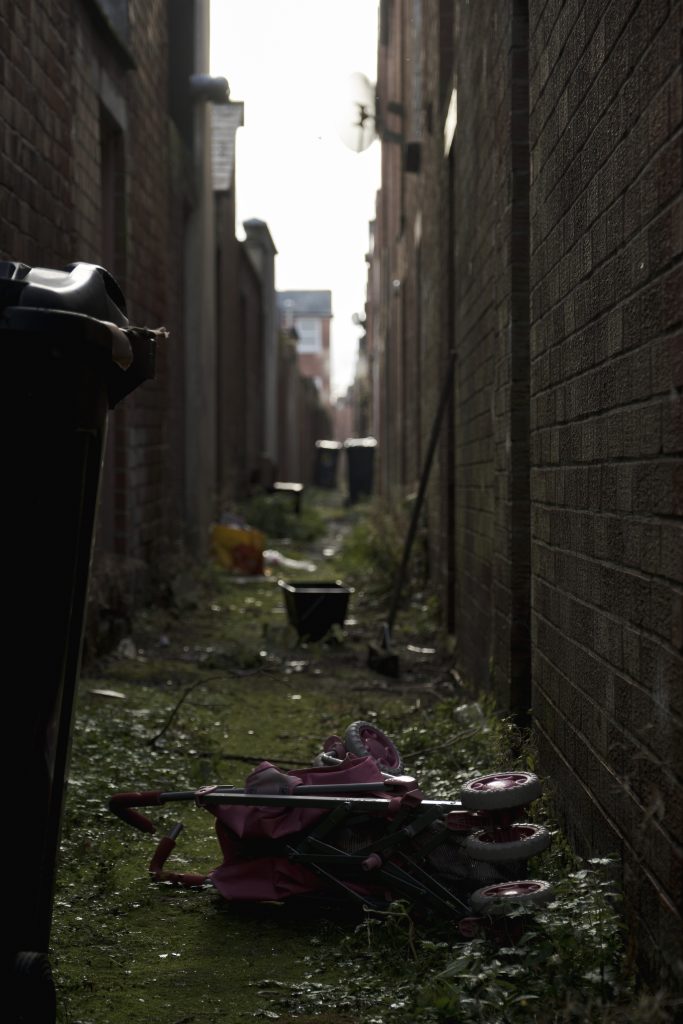
Image: Alleyway, South Belfast

This has helped inform an initial list of people that we’d like to speak with. As paths had crossed in previous projects and campaigns we requested a meeting with a Green Party Councillor (Aíne Groogan), which multiplied into 4 Green Party Councillors (4 Councillors! we applaud their enthusiasm for alleyways) and a meeting via ZOOM. 

The Councillors (Aíne Groogan, Mal O’Hara, Brian Smyth & Anthony Flynn) were keen to see an alternative story develop, saying that alley gates were a panacea to a very complex issue. We talked about burglaries, fly-tipping, management, and ownership of alleyways. On average councillors in one part of Belfast are receiving requests for alley gates 3 times per week. This is unmanageable in terms of resource required. Each gate costs approximately £3,000 and perhaps there are 2 or 3 or 5 gates needed per alleyway. And then there’s the issue around ownership. It’s not always easy to establish ownership of an alleyway. 

This was a great development quite early in the investigation. We started to think about alternatives to what happens now. We decided to develop a series of design concepts (alternative stories) that could make alleyways safer, cleaner and permeable. They would need to be more cost effective than gates and not necessarily require sign off by the ‘owner’ of an alleyway. These concepts can provide visual stimulation and could potentially be piloted and evaluated in different parts of the city. 

“Could be a real game changer for Belfast, maximising space. & improving connectivity” Aíne Groogan, Green Party Councillor

Categories
Events Journal

Alley as a Gallery

An event called Liminal (Space) Belfast caught our attention and we booked tickets for this very short alley walk, which was a curated installation and exhibition over the course of an afternoon. Liminal (Space) Belfast is a pop up event showcasing art and artists in the public realm.

‘Liminal Belfast – an exhibition in an alley. It’s a (free) sell-out, a steady trickle of visitors passing through.

T-junction: two ways in, only one way out.

Art about lockdown.  Glass, blueprint, screen projection, installations.

Lungs, insects, shattered glass, still holding itself together, just.  

Shredded leaves of a book, still attached at the spine, flutter in the wind. It is very windy.’

Image: Alleyway, East Belfast. Liminal (Space) Belfast.

We chatted with the artists about using the alley as an inspiration and a place to show work. We were reminded of Artist Jonathan Brennan’s exhibition ‘Alleys of the East’. The instigator of Liminal (Space) Belfast, Meadhbh McIlgorm tells us about the preparation that went into making the alleyway suitable for visitors. Days of work clearing and cleaning the space. A ticketing system to keep numbers manageable for social distancing. Conversations with neighbours about the back walls of their yards. Could they use the wall to hang work? Management of an unmanaged space, Liminal (Space) Belfast turns the alley into a place.

Categories
Journal

What’s in a Name? An Alleyway in 1902

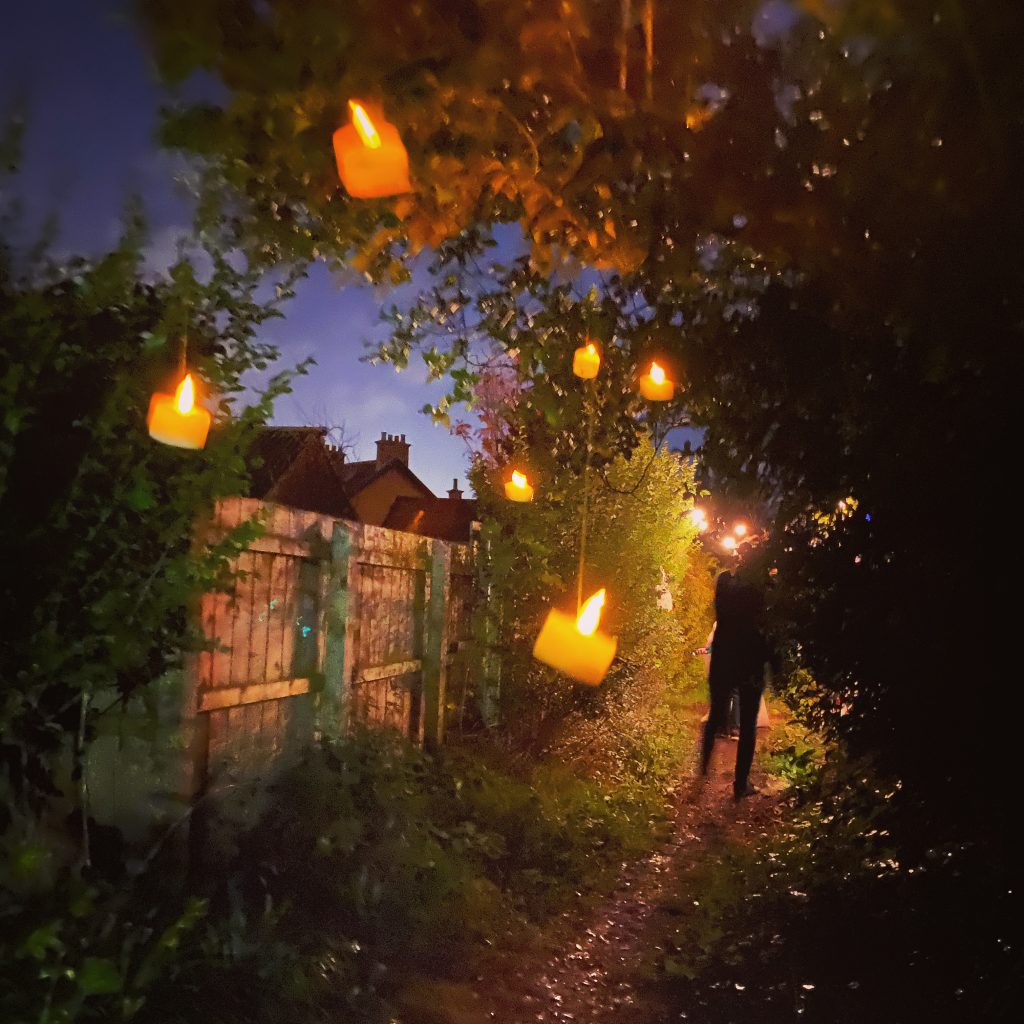
The name 9ft in Common is inspired by a lease first signed in December 1902, confirming a right of way over and along a 9ft passage in Belfast. It was designed to be a space that could be accessed by all landowners and tenants within the houses, whose boundaries back onto it. 

Although in quite recent years it had been used as a shared space to play, it had also become a place to leave unwanted things, a place to forget. The buddleia and blackberries grew until the 9ft passage was no longer passable. The unadopted status and unknown ownership had led to a demise of the passage, until a group of neighbours checked their leases and decided to reclaim the 9ft in common.

Image: Alleyway, East Belfast (temporary lighting installation by No.52)

Categories
Journal

Alley Walk in East Belfast

Part of our methodology is to walk in alleyways and to record what we find by writing from memory. Two stories of one journey. You will find parts of these recordings sprinkled throughout future journal entries, but for this first alleyway walk we are sharing the full unedited stories:

Amberlea

We meet at the front door and walk towards the back. The alley sits separate from other alleys. A linear green corridor with a forged path along the middle where you can avoid the nettles. Garages, gates, a car engine. Wooden fences run along both sides until we meet the tall red brick wall on our right. The original separation of land. We walk along, turn left and we are back onto the street. 

Across the road, the alleyways are concrete. Bins spill onto the footpath. The ghosts of windows blocked up with new brick. We meet a neighbour who uses the alleys to walk a new dog. A safe space to get the dog used to the neighbourhood. We can walk this way for another few streets. The backs, the fronts, the backs, the fronts.

We change direction and head towards the city this time. Beginning to weave upwards and downwards now as the alleys are on a hill. Towards and away from the centre of the city and the hills in the distance. We venture around a corner where the fence keeps the playground safe on the other side. The path leads us uphill. It’s very narrow. To the right we have a plot of land, overgrown and neglected. Apple trees spill over from the gardens on the other side. Meanwhile on the path we have bins, car tyres, a kitchen sink. The space gets narrower and we can touch both sides at once. A carpet of leaves from overhanging shrubs. We emerge at the top to say hello to builders.

Another series of alleys again lead us up and down. Doors painted yellow, blue, green. A bright pink wall. A red garage. Glossy gates. Open on one side with metal railings. A patch of maintained shrubs lead us to a junction. To the right, a mossy narrow space with green underfoot. To the left it’s much wider. Pavers, and weeds to the knees. We choose the moss.

Aisling

A walk in Belfast barely seeing a soul, 

and conversation when we did. 

Distancing is easy here. 

Cracks in the wall 

Windows on gables and well tended boundaries. 

Look, someone upstairs is 

home working with an alley view. 

Nasturtiums spilling out 

Large slabs of slate every few steps

Along the narrow alley

Nature taking over, 

trees rooted in brickwork, 

overgrown buddleia

Broken glass atop a wall, do not enter

Abandoned chairs, facing the wall.

Thresholds, thresholds, thresholds.

Some accesses built over 

with garages – was it ever thus?

Two fresh oranges and a bike 

in an open back yard,

Begs many questions.

Beautiful manhole covers, 

Cast iron circles, with grass in the cracks.

Blocked drains giving rise to puddles of reflection 

Broken bricks, metal grilles

Hollow-sounding footsteps here,

We must be over a culverted drain.

More dog poo as our walk continues,

hopscotching around it. 

Oops, Amber-alley! 

Amberlea of the alley

Alley ambles with Amberlea,

I’m not done yet.

Noticing the impact of paramilitary graffiti

To make you feel more on edge, 

a little less free.

UVF, kiss kiss.

Categories
Journal

The Brief

We are Amberlea Neely and Aisling Rusk of Starling Start and Studio idir. We are researchers, creative producers and designers. We are citizens of Belfast. We come with a background in the disconnection and connection of people and places. We’re interested in spaces and how people use them. We’re interested in local activism. We’re curious about ownership and access. Our approach is collaborative, democratic, and always a little playful. We like to find common ground.

Belfast’s terraces are built around a complex network of entries, alleyways, and commonages. Once used as access for important coal deliveries and sewage networks, this infrastructure has been demoted to bin runs, leading to areas of dysfunction with fly tipping and antisocial behaviour. However, as COVID-19 continues to restrict social interactions, these wild, liminal spaces present an opportunity to those craving spaces beyond their homes.  They can become places to grow, places to play, places to come together in a ‘rurbanisation’ of the ‘entries’, as they are locally known.

Some of Belfast’s alleyways are adopted, meaning that they receive the same treatment that a public footpath or road might. Some are unadopted. Forgotten. They have no rules. Are they public places? Do they belong to us? Who looks after them? The information exists, but’s not public. It’s hard to find… We’d like to track down this useful information and make it publicly available and easy to understand. An alleygating initiative has been underway over the last decade to enclose adopted alleys in a call to reduce antisocial behaviour. A further round of alleygating is soon set to get underway through Belfast City Council, and is typically popular with local residents, who feel that “the open nature of the alleys leaves them vulnerable to sabotage”. (Kenwood, Belfast Live, 2020). We ask questions about the wider use of the alleyways for play, growth and connection over alleygating and nimbyism, and will take advantage of their non-adopted, liminal status to provoke and promote their wider usage. The investigation echoes emerging research around resilience, people friendly neighbourhoods, hyperlocalism and The 15 Minute City which could have both local and wider reaching significance.

We want to stimulate debate around these common spaces, to learn about the history and explore the future of them. We want to celebrate the community stories from lockdown and before, of alleyways transformed by collective effort into thriving local community hubs. We want our fellow citizens to know how to make better use of these spaces. This community investigation makes hidden information public. It challenges the top down approach. It creates discussion around who owns the city. It creates the possibility for a collection of spaces. It might encourage people to stay on in the city rather than move to the suburbs, a problem Belfast faces. It shifts power into the hands of the people of this city. Autonomy. It creates common ground and the potential for increased wellbeing.

9ft in Common will explore the open and closed alleys of Belfast, promoting not just the collective appropriation of your own local alleyway, but their use by others as part of an expanding network of off-road walking routes through the city, desire lines connecting the city’s existing partial and fragmented greenway infrastructure.