Categories
Events Gatherings Journal

The Garden Cannot Be Unplanted – Phillip McCrilly

An alleyway commission responding to the harvest theme of ‘feast’.

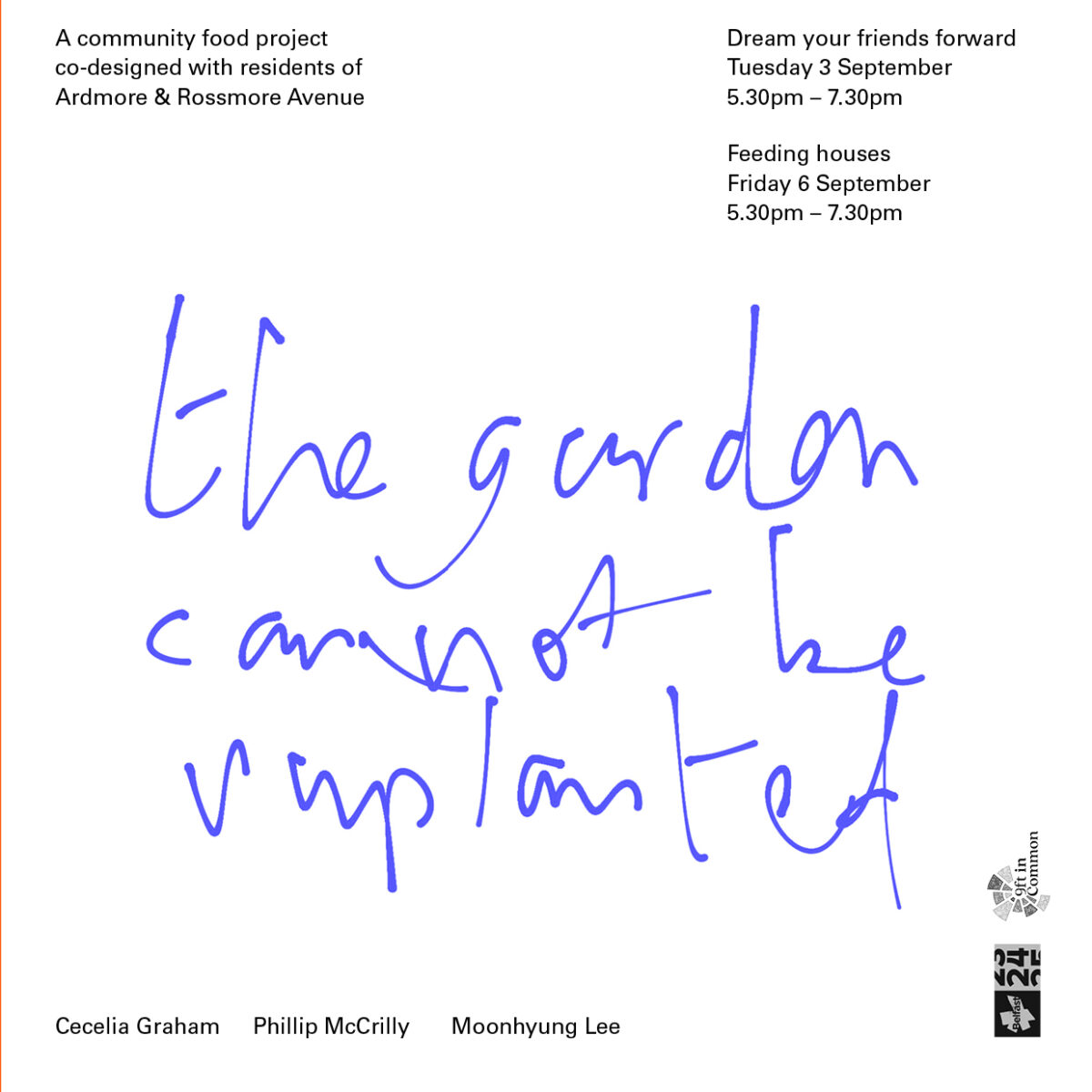
9ft in Common is delighted to introduce a new alley artist commission with Belfast based artist and chef Phillip McCrilly. Knowing his thoughtful, considered and delicious work, and that he’s a resident of the beautiful Ardmore-Rossmore Alley in South Belfast, we approached Phillip to design a creative response to our Lughnasadh theme of Feast. 

In our initial chat we spoke about the values and research interests of 9ft in Common – how we are interested in the alleys as places for connection between neighbours, how growing in a shared space also grows relationships and how shared food – a cup of tea, a slice of cake – is often the first step in building these community initiatives. 

Phillip, interested in the transgressive and interdisciplinary possibilities of food and hospitality, had no shortage of ideas and thought it would pair well with another collaborative project he had on, supported by the British Art Network, where he was keen to collaborate with chef Moonhyung Lee and curator Cecelia Graham. We said; yes please, the more the merrier – and just love the proposal he’s come back to us with ‘This Garden Cannot Be Unplanted’ – Check back here, and @phillipmccrilly (instagram) for more details as the project unfolds over the coming weeks.

Learn more about Phillip’s concept. Video Simon Mills

This Garden Cannot Be Unplanted

The project responds to a history of transformative domestic hospitality, reciprocal and alternative economies, as well as a legacy of community-based food initiatives, and has been co-designed with residents of Ardmore and Rossmore Avenue.

Taking the shape of a public workshop, an alleyway dinner for residents and the introduction of a shared equipment and ingredient resource, the commission responds to and is facilitated by the unique nature of the alleyway as a space started and shared by the street’s inhabitants. We seek to consider how this particular site can propose new systems of togetherness and support.

‘The garden cannot be unplanted’ is a 9ft in Common commission by Phillip McCrilly in collaboration with Moonhyung Lee and Cecelia Graham as part of Belfast 2024.
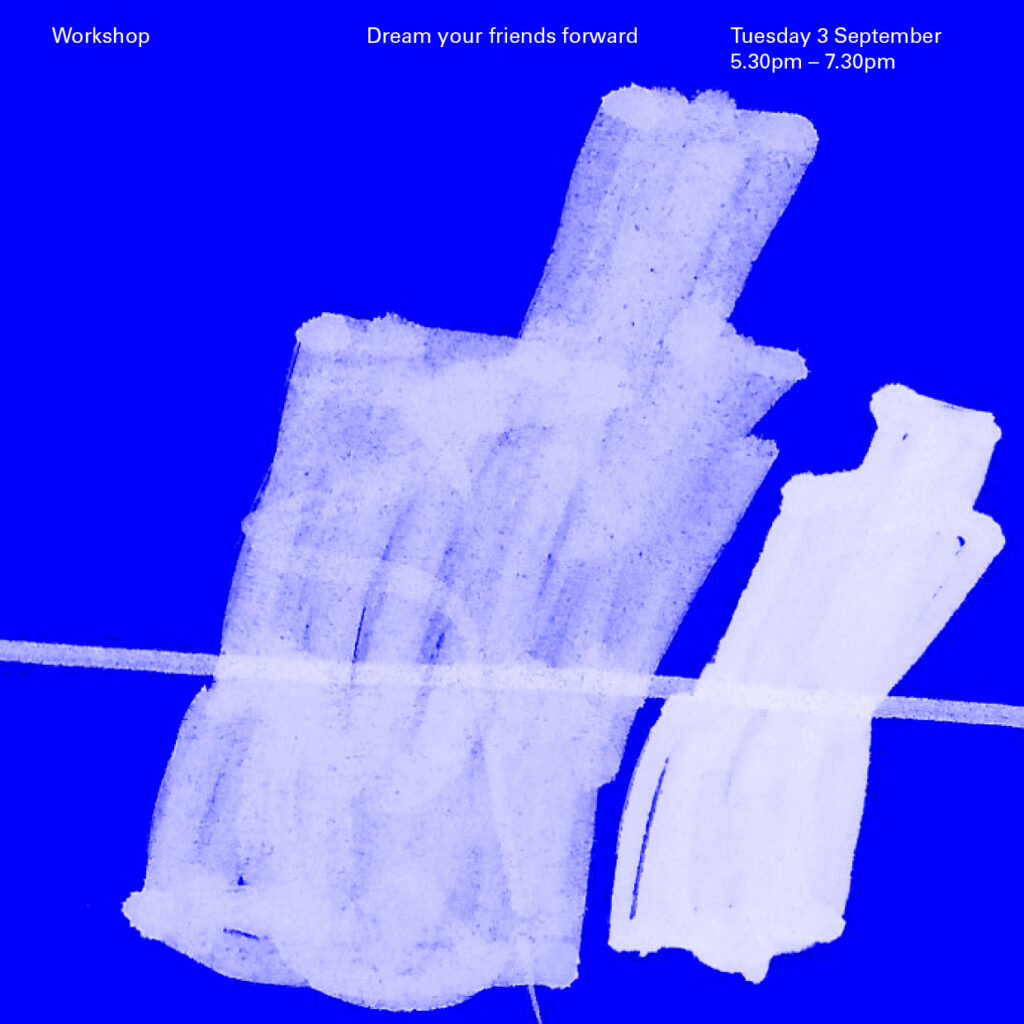
Workshop: Dream your friends forward

Tuesday 3 September 2024 5.30pm – 7.30pm
(now fully booked)

‘Dream your friends forward’ brings together a group to collectively engage in and consider the act of neighbourly foraging. We will contemplate how acts of companionship and exchange enable us to cultivate new ways of being that put forward alternative economies, and build upon forms of knowledge that emerge from our surrounding environment, neighbours and soon-to-be friendships.

Funded by British Art Network.
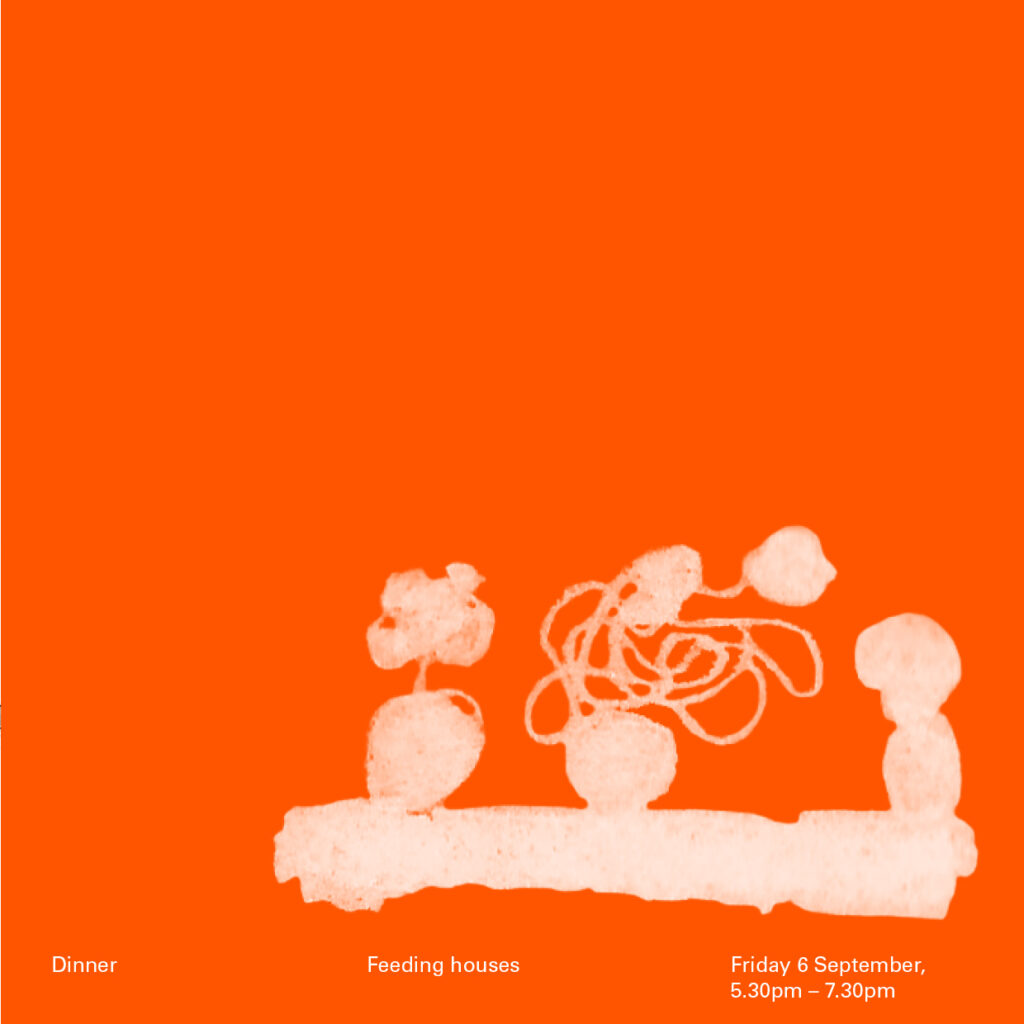
Dinner: Feeding Houses

Friday September 6th

Participant/Invite Only

Further Details to be shared soon.

About the Artist
Phillip McCrilly is a Belfast-based artist and chef. Interested in the transgressive and interdisciplinary possibilities of food, hospitality and education, he was a participant within the Gramouce’s first alternative MA in Food & Art Studies, as well as a former co-director of artist-run spaces, FRUIT SHOP and Catalyst Arts. Considering cruising and foraging as likeminded deviant practices, his research centres around queer collective acts of land and property reclamation. Recent projects include wet HEAT sweats without scent, a Platform Commission for 40th edition of EVA International, and Meals and Sandwiches, a series of kitchen-based residencies at The American Bar, and Bakari Bakery, Belfast. 
Categories
Gatherings Journal

Wild Service

We first met Emily McIlwaine who is an artist, a weaver and a mother via the application to our Growing Potential project back in January. We couldn’t include everyone who applied to that project, but we came back to her and the neighbours of Hyndford Street for our beautiful Bealtaine Gathering. We knew then that this alley and the people that lived on it still had more creative goodness to share.

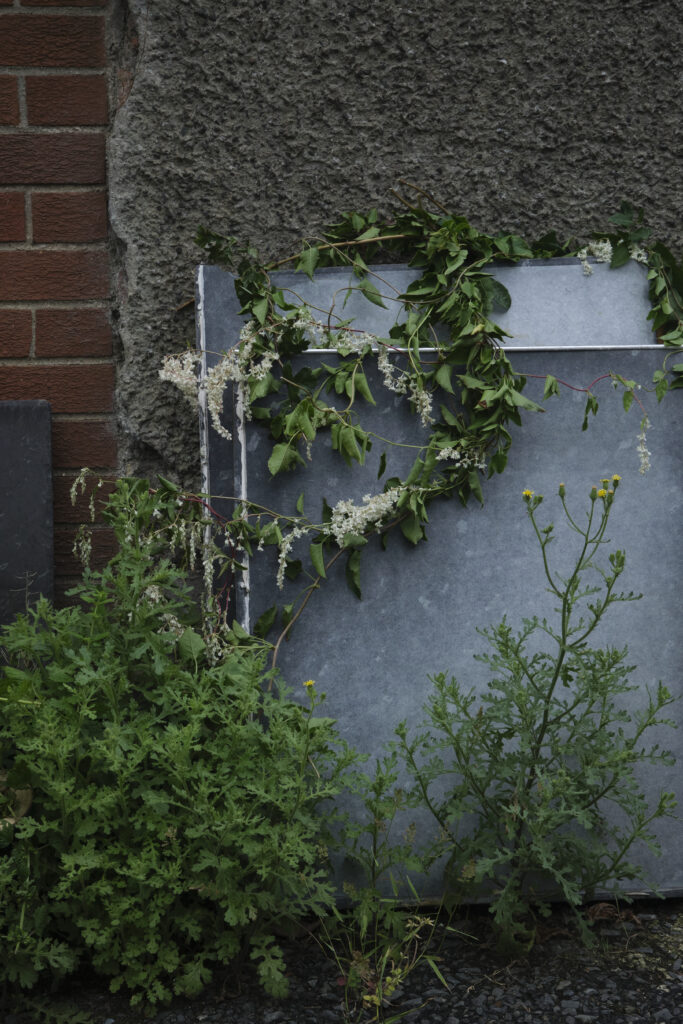
The alley is intriguing. Closer to Bloomfield Road it is gated but this segment is open. The surface is so uneven that the council will only collect the bins from the top end or the entrance known as the ‘wedge’ on Alberta Parade. It’s a wild and liminal space for sure with weeds and moss in an ongoing battle with the tarmac. We asked Emily if she would like to take on one of our alley commissions, looking at weaving with willow and wool in different ways and presenting whatever those results might be in the alley for Lughnasadh as craft is one of our celebration themes for the season.

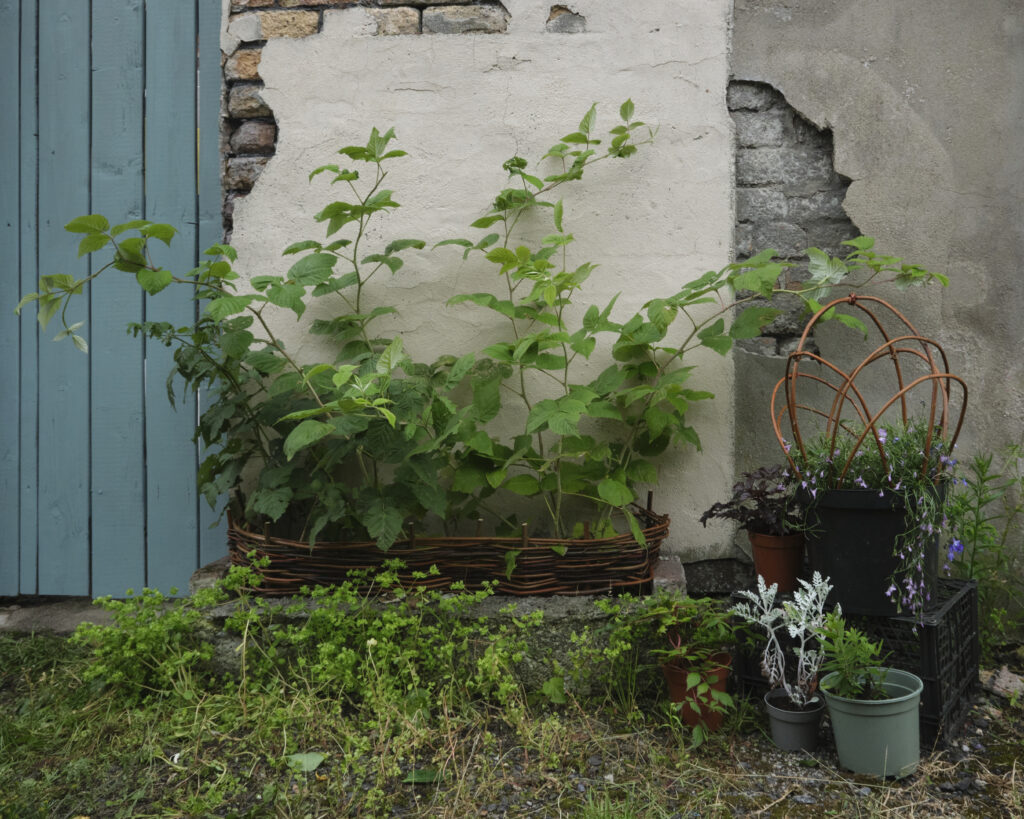
Woven willow structures for plants.

As part of the process we had some lovely conversions. We spoke about nests – nesting herons on the greenway and nesting in the context of making a house a home. We talked about making, and making the most of whatever outside space you have from the tiny yard to the alley – especially important with a small child and the challenges that come with that too. It is interesting that for the majority of the alley growing projects that we have encountered there is usually a determined woman at the centre, on a mission to make the edges of home that bit nicer. We hoped that presenting this type of work in the alley would continue to soften its landscape for those that lived there. 

noticing, honouring and supporting what is already there growing.

Emily suggested ‘Wild Service’ as a title for the project, inspired by the book of the same name, edited by the Right to Roam advocate Nick Hayes. The book argues that humanity’s loss and nature’s need are two sides of the same story and calls for mass reconnection to the land and a commitment to its restoration, celebrating the presence of humans in nature. 

Wild service: the concept of service is vital to this new beginning. It subverts the culture of our time which sees nature as a resource to be exploited and humans… Instead, it allows us to begin from a radically altered position of deference… to the land itself. (Hayes, N., 2024, pg xiii )   

In her artistic practice working predominantly with natural fibres and dyes, Emily explores the influence of Irish tradition, myth and the celtic wheel – already an amazing fit for our programme!
About her approach she said:  

I like the idea that I’m not removing what nature is doing with the alley (weeds!) but I am honouring and adding to the space with objects that are made out of natural materials, which could be left to the alley without making an environmental impact. On another level I’ve been thinking about Lughnasadh and the rituals involved with that to show reverence and gratitude to the earth for what it gives us.

The beauty of commissions is that it’s a process of trust and transformation. You shake all of these ideas around and trust that the artist is going to translate it into something magic. As well as some experiments with willow structures for supporting plants that she had propagated, grown and cared for, Emily couldn’t resist using the opportunity to create some new weaves on the loom, and the results were marvellous. 

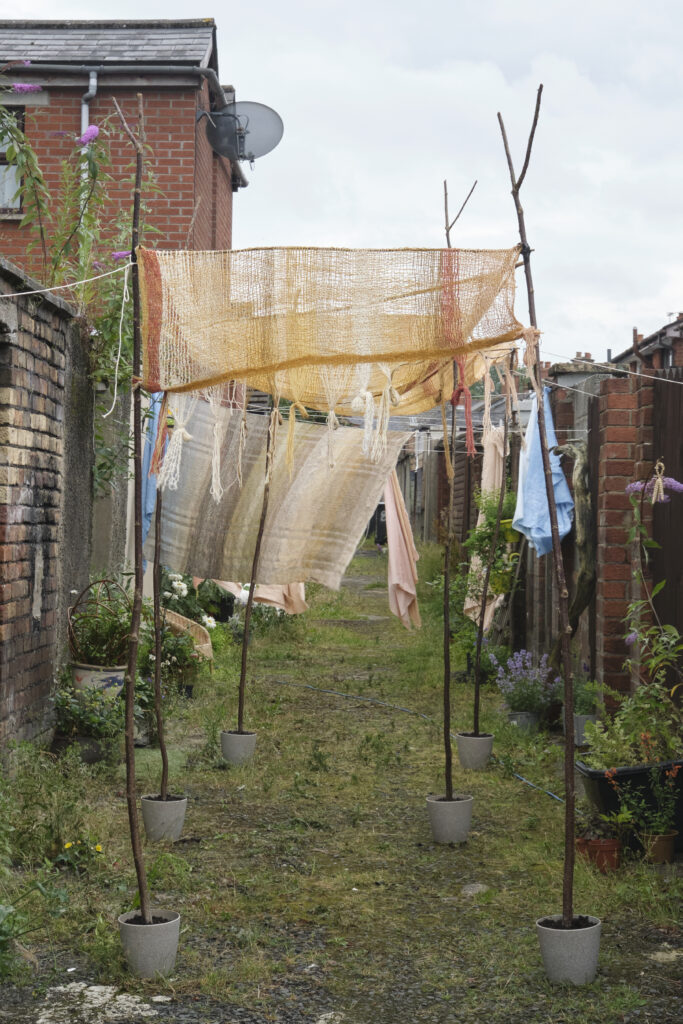
Woven Canopy.

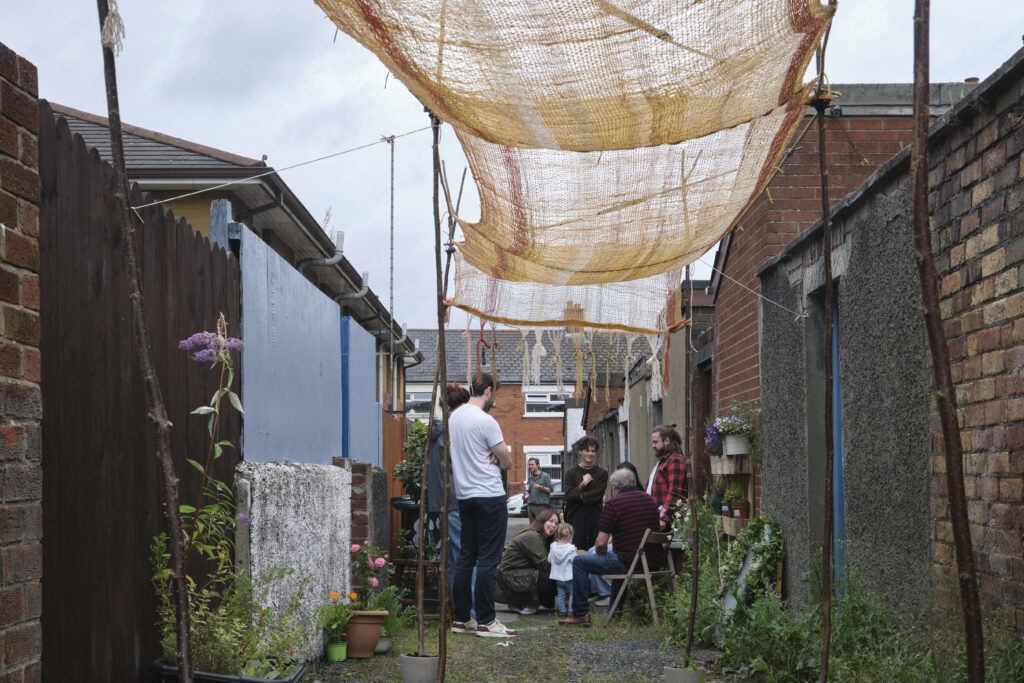
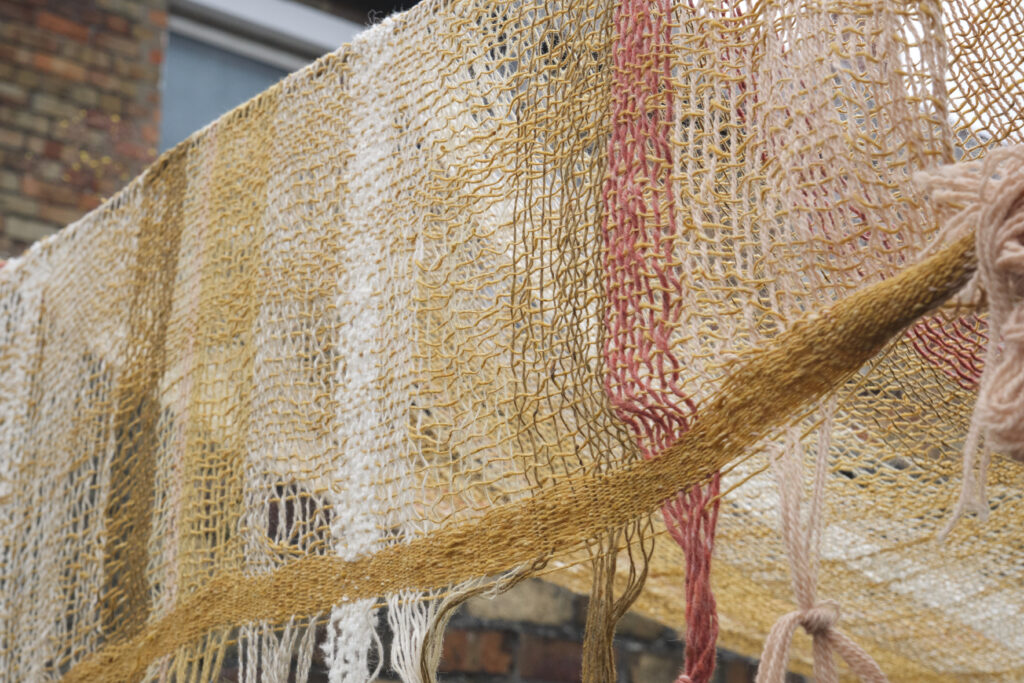
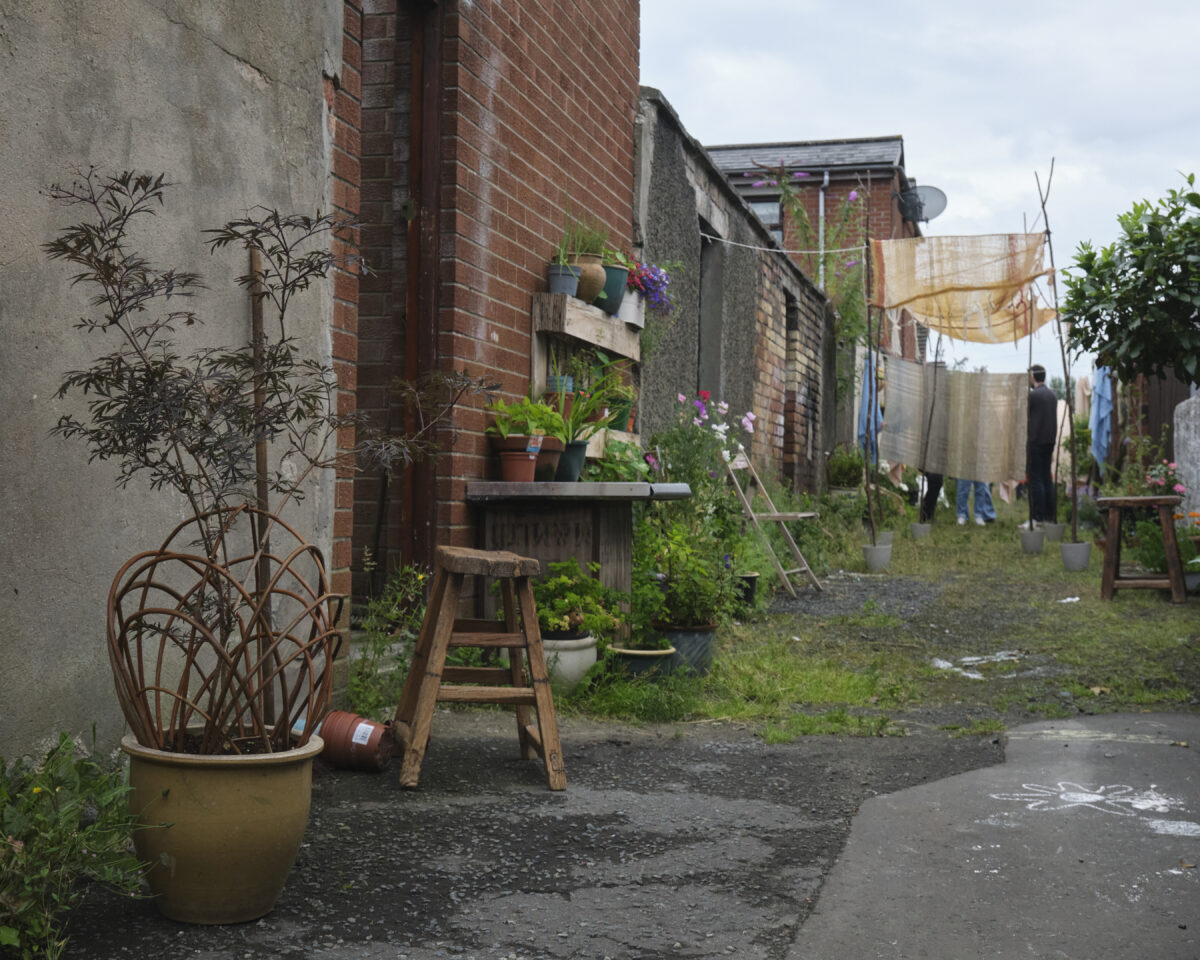
The most striking piece was a large woven canopy made with naturally dyed yarn in a beautiful ombre of oranges and rusts. The canopy was precariously draped over branches arranged to look like the beginnings of a living willow arch. Through the gorgeous open weave you got snippets of walls, roofs and sky. The grids of threads echoing the grids of brick. It billowed in the wind, almost regal, as if marking a grand entrance, something palatial, with plants and greenery lining its sides. 

detail of colours.

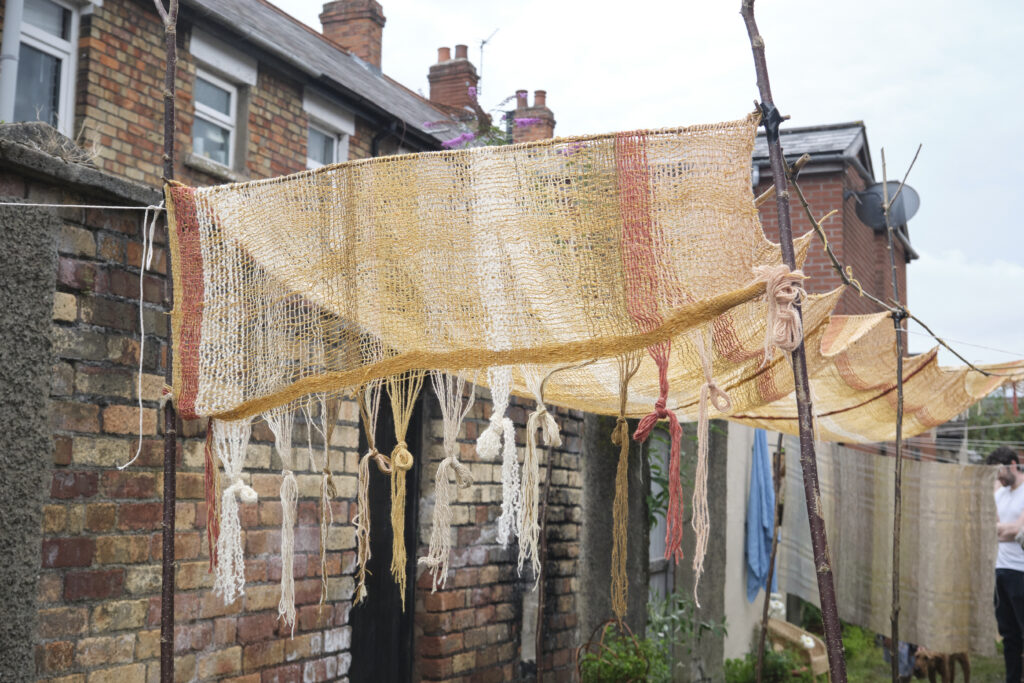
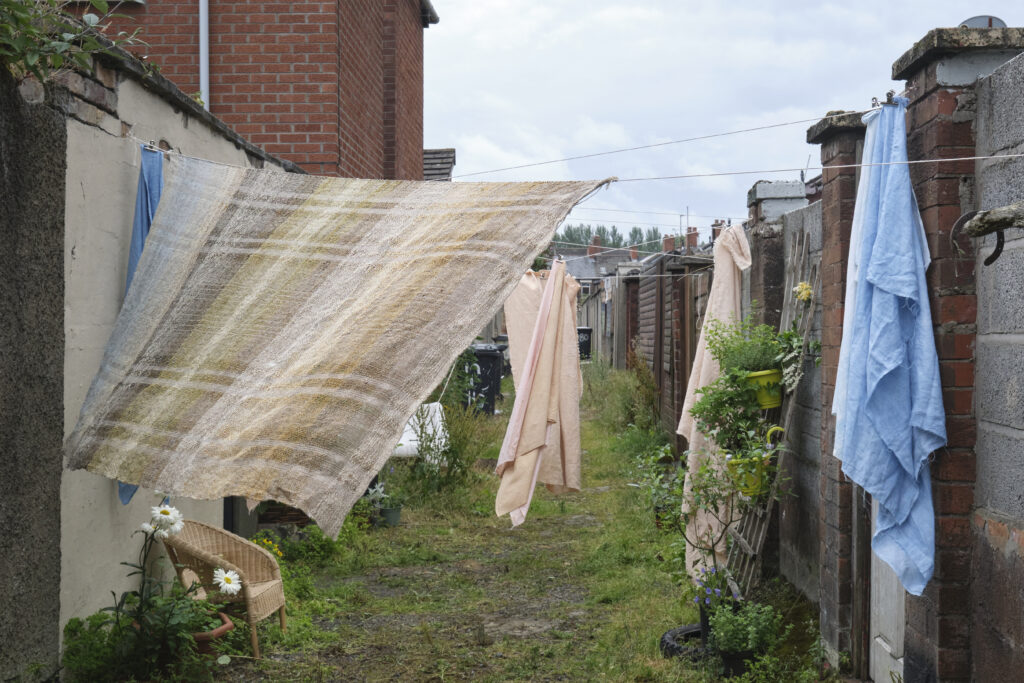
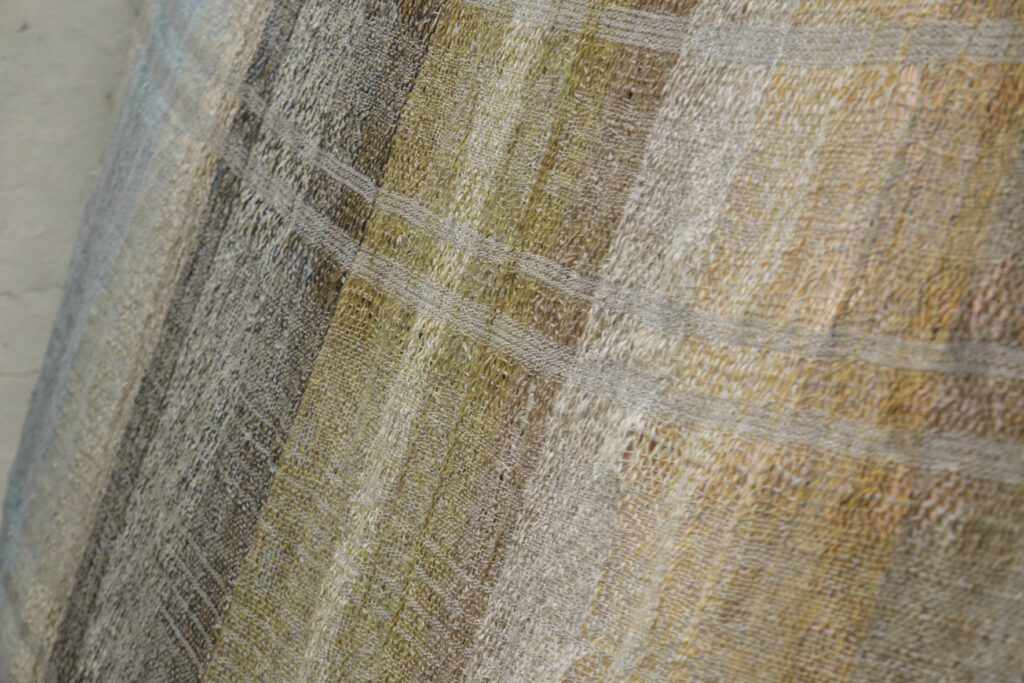
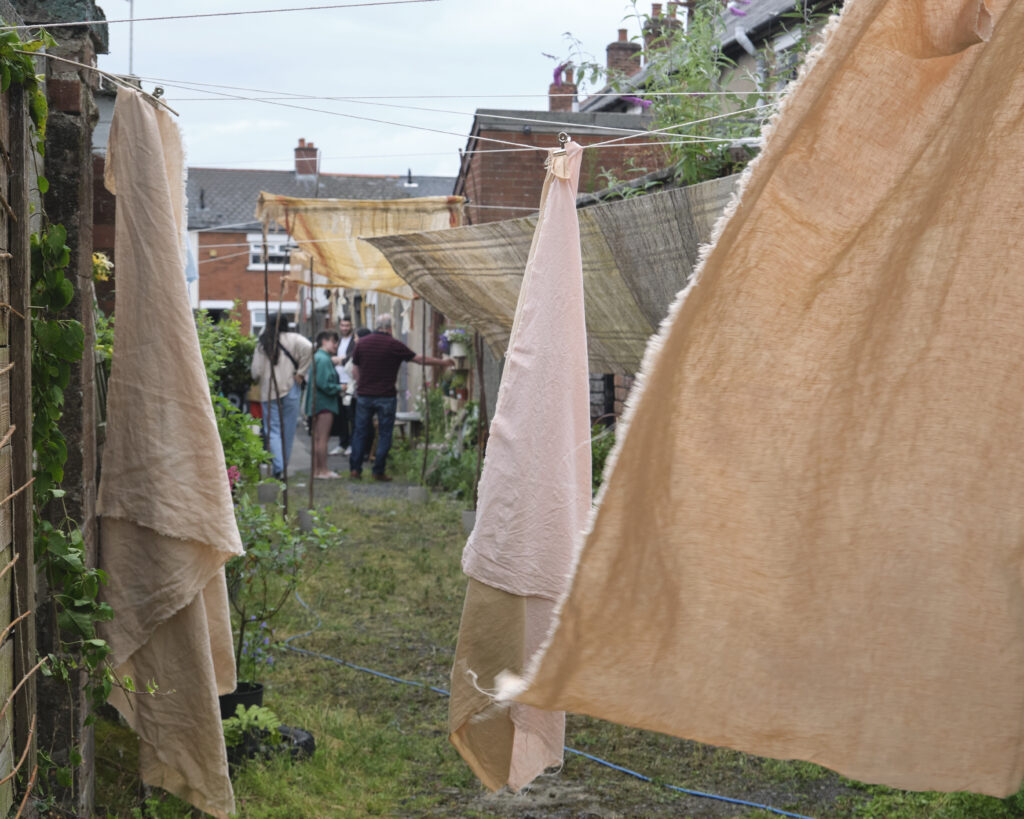
The second woven piece was more subtle, made with a mixture of Donegal Yarns and linen. We felt like this piece reflected all the muted urban colours of the alley – chalky stoney neutrals, like patches of exposed brick and peeling paint. Terracottas and rusty brown. Earth tones and greyish blues. It was the first piece you encountered hung on a series of strings, reminiscent of washing lines. Emily’s practice is process led, there was no fixed final presentation conceived at the beginning of making but she said she ‘wanted to make objects that felt airy and spacious but also broke up the space and were semi interactive’. 

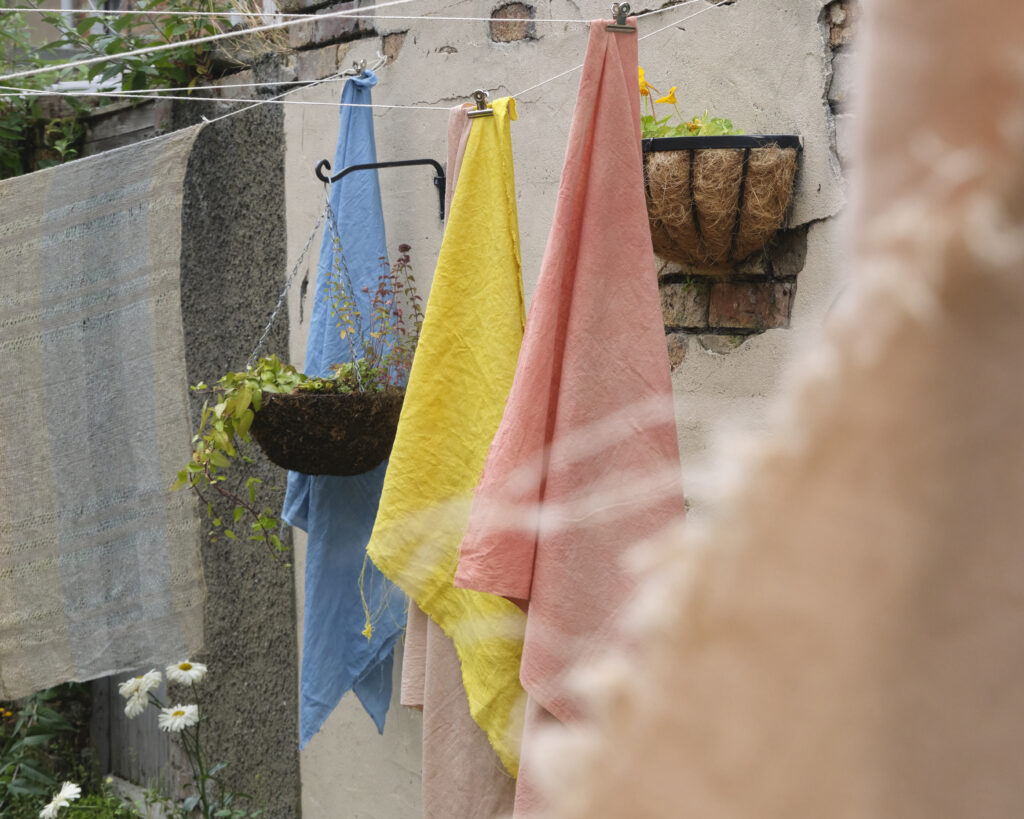
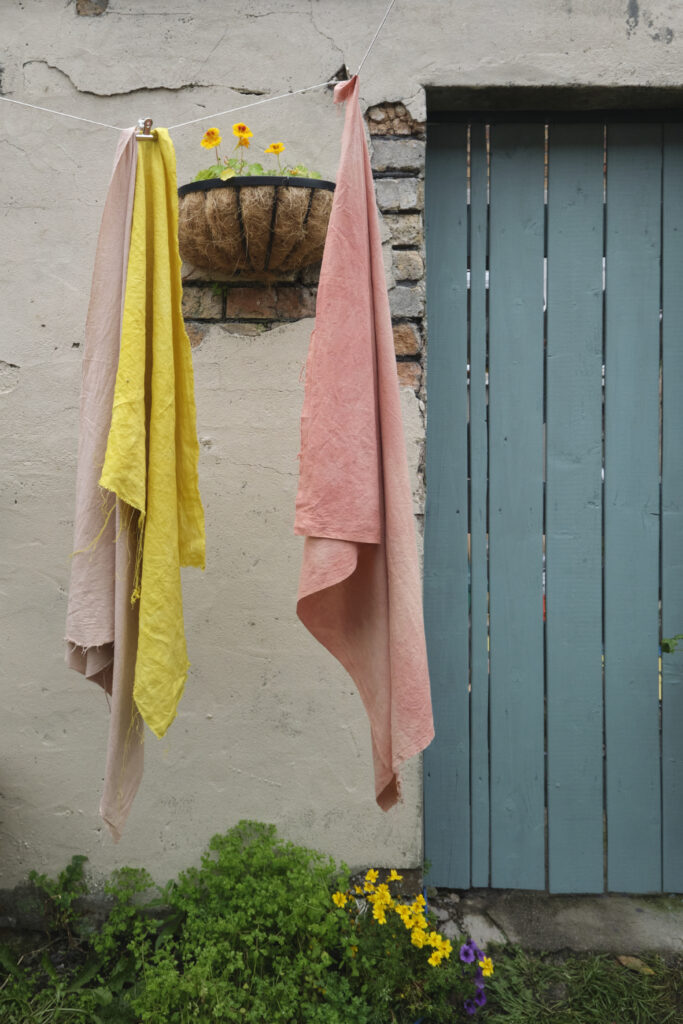
Following on behind the woven piece, a selection of coloured linens drape and billow from the makeshift ‘lines’. Some are peachy, one is vibrant yellow, another is steely blue. The natural plant dyes she used included woad, weld, avocado and madder. For me, it’s hard to look at linens on the line and not think about the heritage of these terrace houses that were likely built for the workers of Owen O’Cork Mill on the Beersbridge Road, less than 500 metres away from where we are standing. There’s a deep history of work with fabric and fibre in the area and I’m sure at many stages the alleys were overrun with busy women and washing lines – sure how else would anything get aired and dried? I’m sure some of the neighbours think we are mad but who knows, maybe they will be inspired to occupy the space on the next good day for drying.

Exhibitions are by nature temporary but this is more temporary than most, lasting only a few hours this Sunday morning. Everyone who drops by stays to talk and chat for a significant time, likely lulled by the mellow soundscape which Joshua, Emily’s husband, had recorded to accompany the experience. The delish sesame flapjacks and mushroom pastries made by Lorna at Tacacucina help too and thankfully the rain holds off. Just as the alley is a throughway, rather than a destination, I imagine that the work Emily has presented will continue to move and transform into something else. We look forward to seeing how both it and the alley here continue to grow and develop. 

Photos throughout by Simon Mills.

Categories
Events Journal

Design Competition: ‘Under the Shelter of Each Other / Ar Scáth a Chéile’

We are delighted to announce this design competition in partnerhip with The Royal Society of Ulster Architects (RSUA) and JP Corry Builders Merchants. RSUA has been running design competitions for early career architects since 2016 with a mix of ideas-only competitions and competitions that aspire to deliver a built project.

With a first prize of £1,500, ‘Under the Shelter of Each Other/ Ar Scáth a Chéile’ challenges designers, makers, and anyone with a good idea, to propose creative ideas for a wall-mounted, collapsible shelter in a residential alleyway in Belfast. 
While the proposals should  be site-specific, concepts submitted should be transferable to other alleys and walls across the city and beyond.

Competition Aims

The competition aims to:

  • Generate debate, interest and discussion on both the heritage and potential future uses of Belfast’s alleyways, as social spaces of connection
  • Explore what role mini design competitions can play in delivering imaginative small projects which enrich the urban environment
  • Give new life to a small piece of leftover space in our built heritage
  • Unleash and showcase the creative talents of designers and makers in Northern Ireland

The deadline for submissions is 4 October 2024.

To register, please email Kerry Campbell on kerry@rsua.org.uk. You will be issued with a unique registration number which will ensure that the submissions are anonymous for judging purposes. Please register as early as possible.

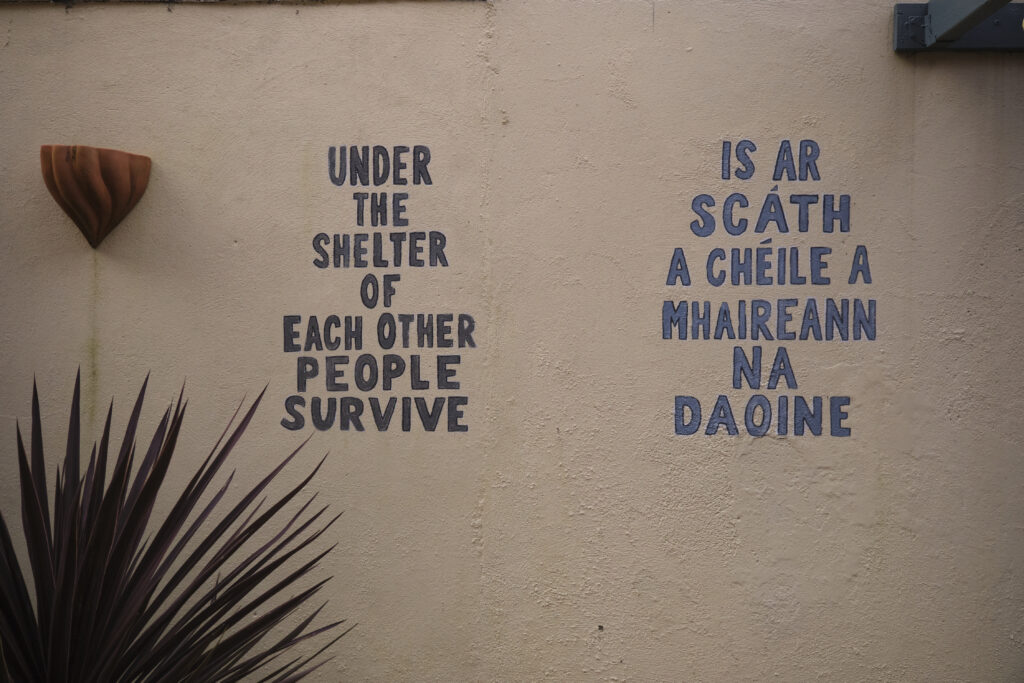
Title inspiration, an Irish proverb and its translation captured in Ardmore Rossmore Alley. Photo by Simon Mills.

Key Information

Brief: Propose a collapsible, wall-mounted shelter in a Belfast alleyway for the good of all residents, which does not obstruct the alley for other users. The shelter should be approximately 2m x 1m when open and provide shelter for at least 2 people. When not in use, it should collapse or fold away to allow safe and easy passage of vehicles and pedestrians along the alley.

Materials: All to be sourced from JP Corry, totalling around £500, or under.

Eligibility: This competition is open to designers and makers, students, or anyone with a good idea, either living or born in Northern Ireland. You are welcome to enter as an individual, or as a team.

Location: The location of the shelter will be announced later in August, to be fixed to a wall in a Belfast alleyway. The design, however, should be replicable anywhere.

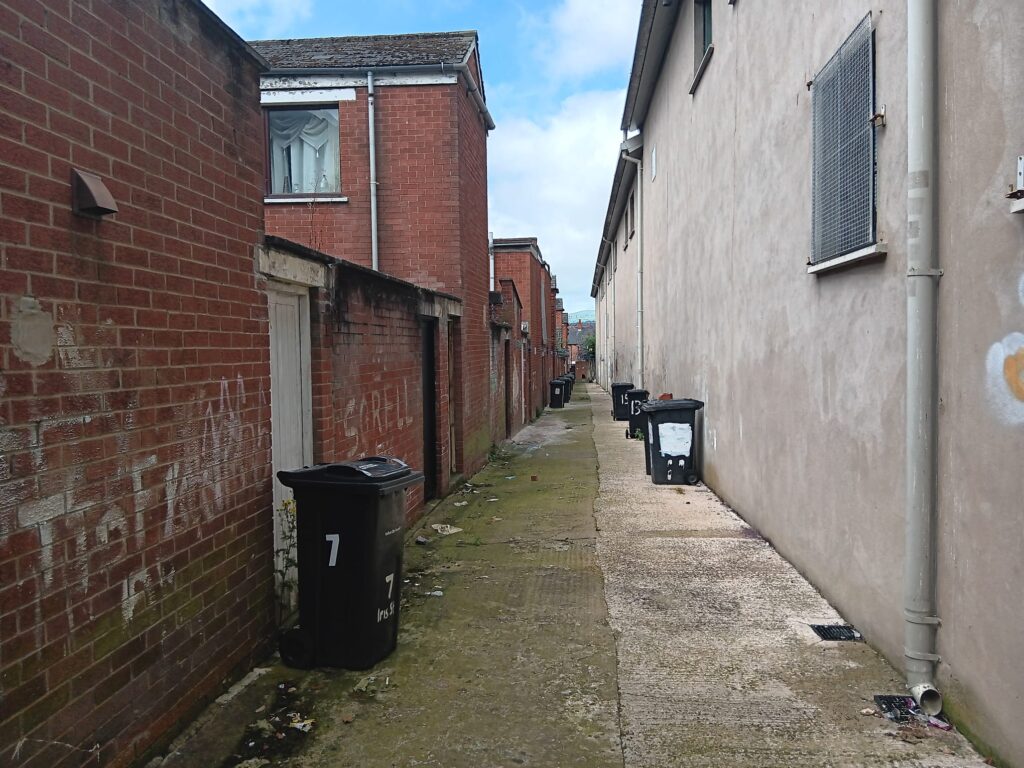
We can now confirm that the alley location for the shelter will be Iris Alley, which is a 9ft wide alley to the northern side of Iris Street, off the Springfield Road in West Belfast. The shelter will be installed on the large grey warehouse wall pictured below, approximately opposite house numbers no.23-25, avoiding the drainpipe.  The alley is gated, so anyone who wishes to undertake a site visit should contact local residents – contact details will be provided once registered.
An overview of the competition, including eligibility to participate, can be viewed here.

Categories
Journal Resources

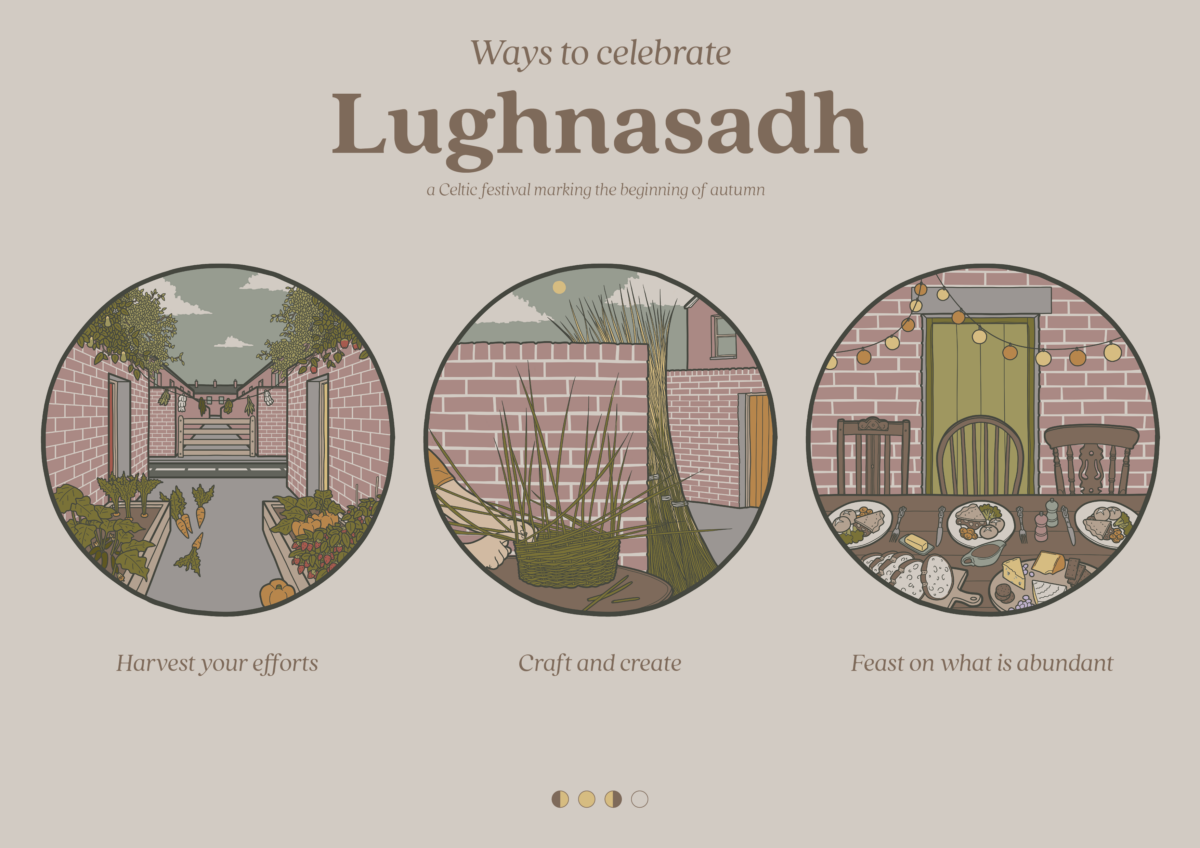
Ways to Celebrate Lughnasadh


Observed around August 1st, Lughnasadh marks the beginning of the harvest season – a time of abundance, gratitude and community. The name comes from the celtic sun god Lugh.

Here are some suggestions for simple yet meaningful ways you can celebrate the season in your alley. 

Harvest your efforts
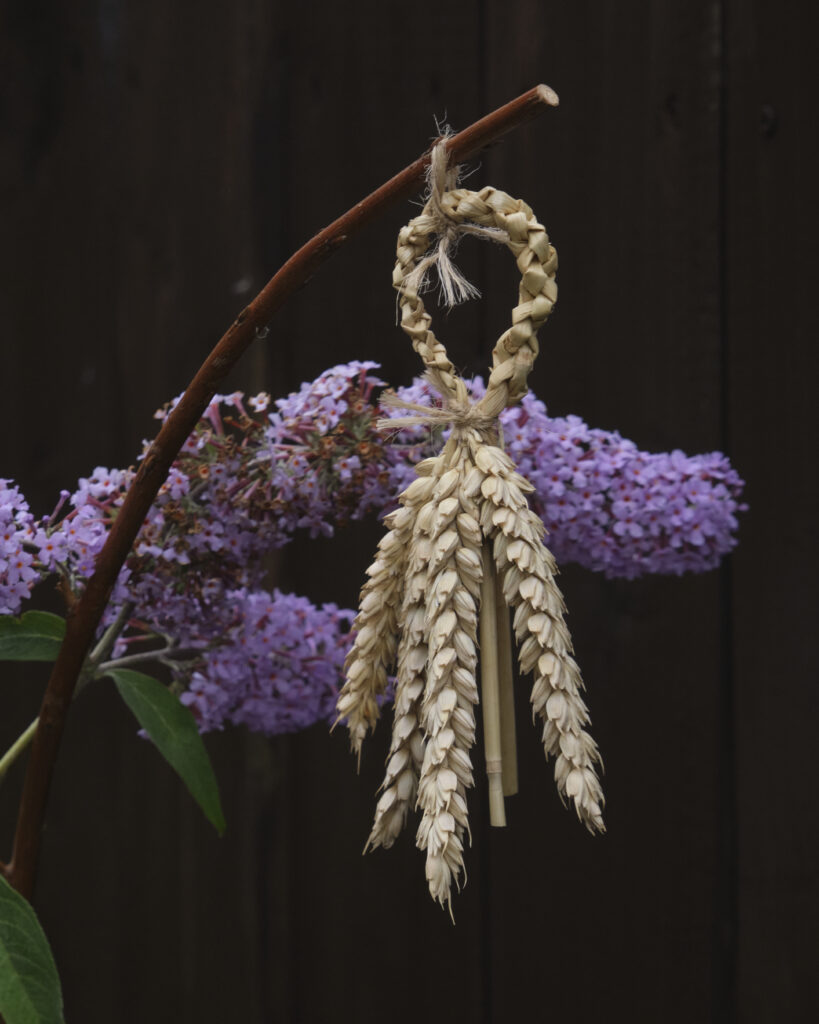
Traditionally, grains were harvested at this time. This is the time of year to gather what you have grown and tended to in the year so far physically and metaphorically. What are the fruits of your labour? Have you grown plants? Can you collect and store their seeds to be planted again next year? 

Craft and Create
Lugh was a god of many skills including craftsmanship. What things can you craft to make the alley a better place? It could be a piece of furniture or a piece of cake. Can you learn a new skill for making something? Or perhaps share your skills and know-how for making the alley a better place with your neighbours?

Feast on what is Abundant
Feasting is an intrinsic human way to celebrate and give thanks. Can you and your neighbours prepare a feast expressing gratitude for the abundance of life? Can you take any homegrown edible plants or flowers and cook something delicious to share? Take a moment before eating to give thanks and praise the efforts of everyone involved. 

Everyone is welcome to try these suggested celebrations to bring the festival of Lughnasadh to an alley near you! Share how you are marking the season – tag @9ftincommon on Instagram and X/Twitter.

We have also programmed a range of gatherings and activities across the city relating to these key themes, perhaps you will be able to celebrate with us. Details will be shared on our Gatherings page.

Bonus Point.
Lughnasadh is a time of gratitude associated with deities that sacrificed themselves for others. Can you sacrifice your time or energy for something? Prehaps you could consider volunteering to help a friend or neighbour out?  
Categories
Journal

Manchester – Day 1

written by Meadhbh & Aisling

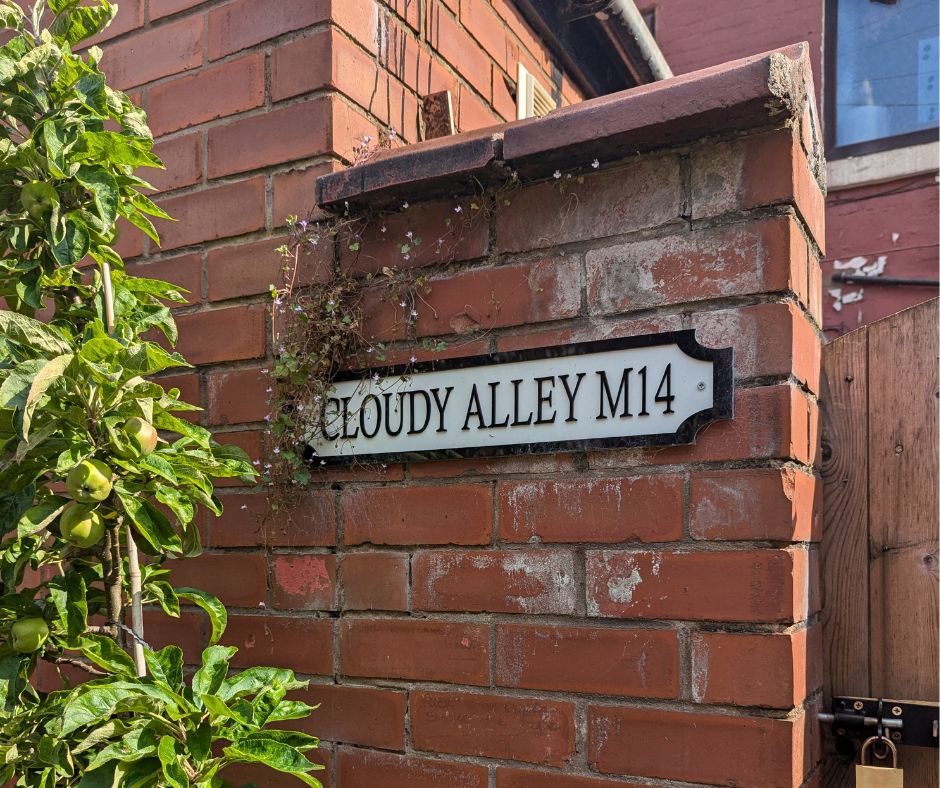
It’s Monday afternoon and we are heading to Moss Side in Manchester to meet Yasmine, an active ‘ginnel gardener’ in Cloudy Alley. 

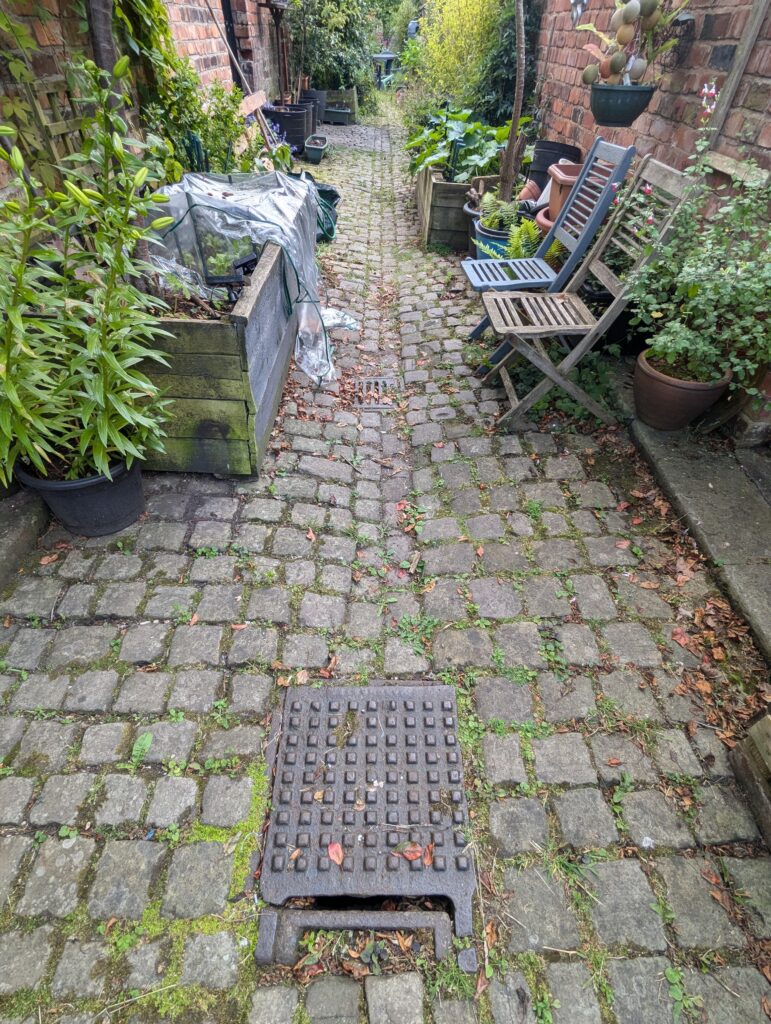
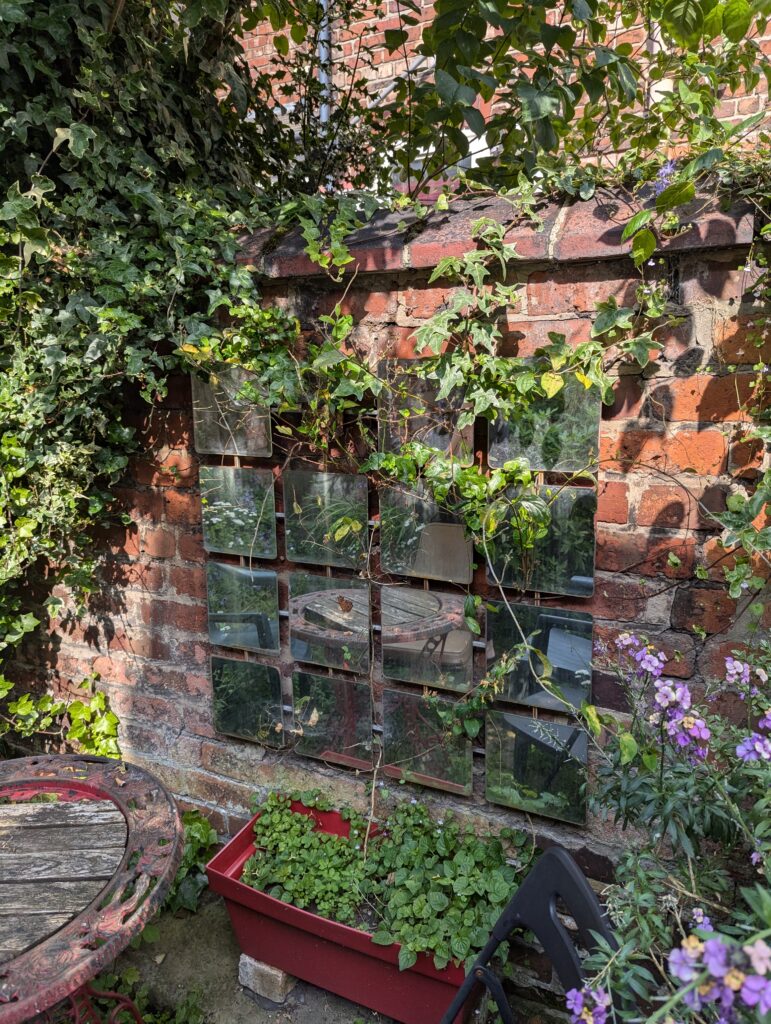
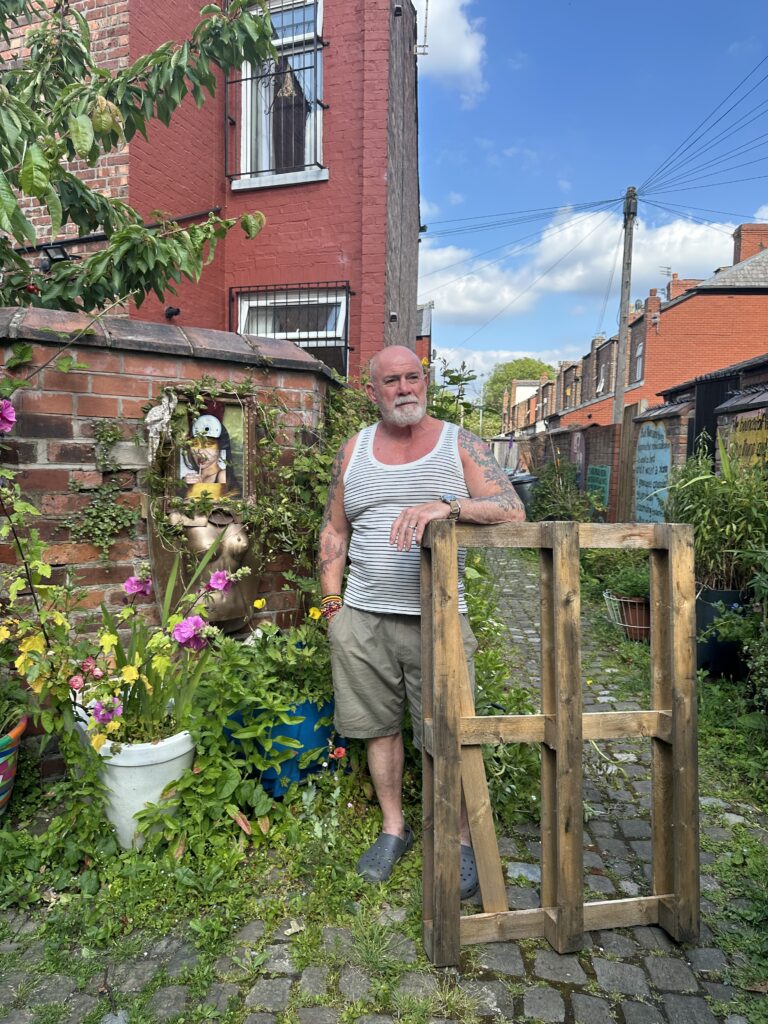
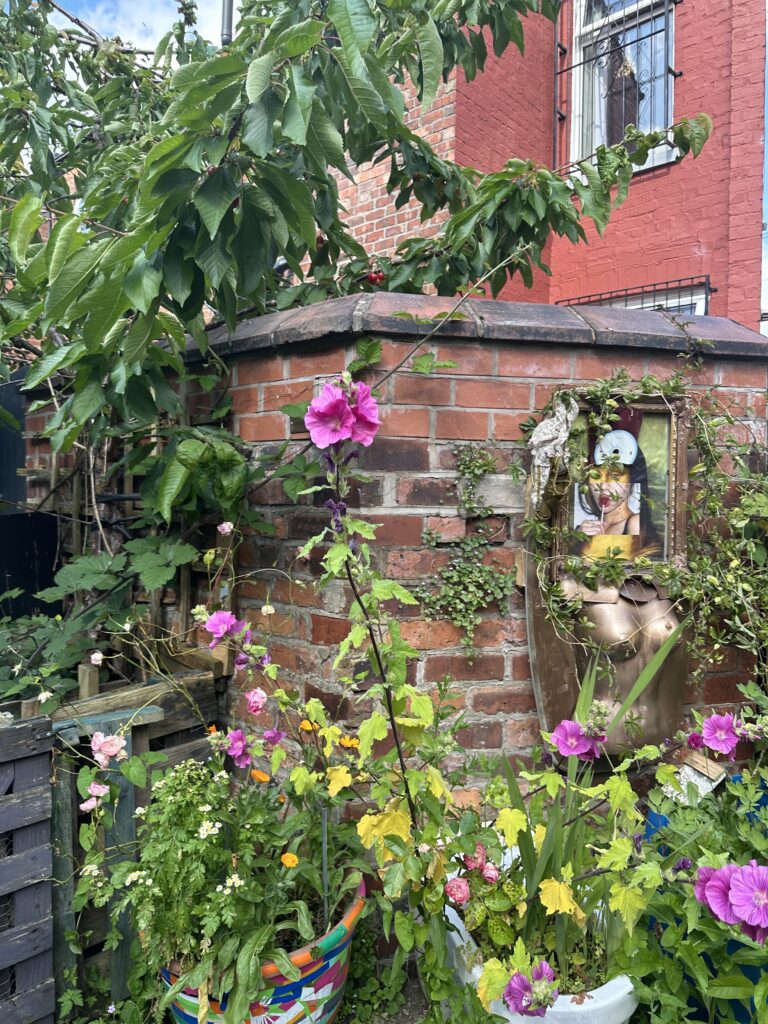
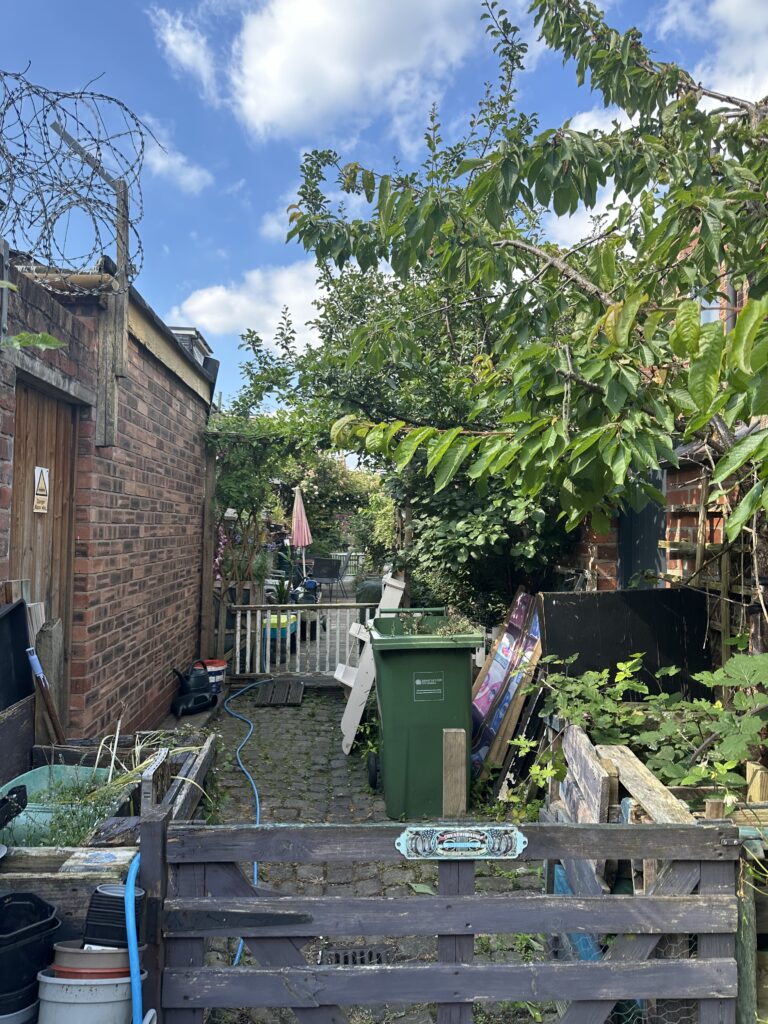
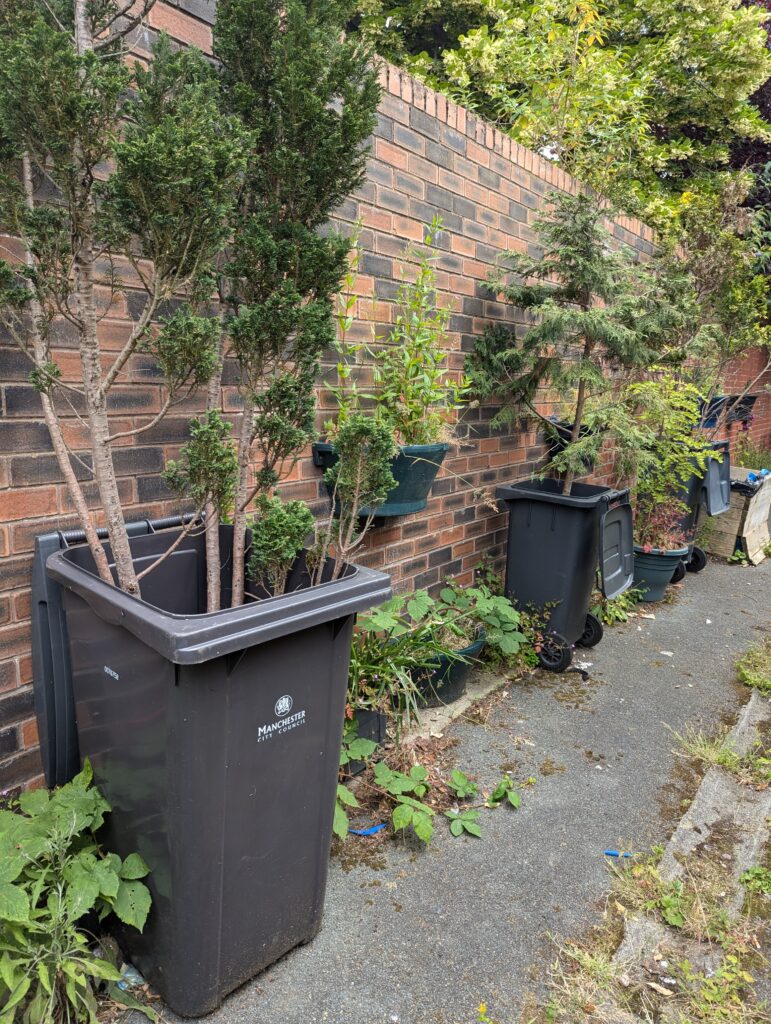
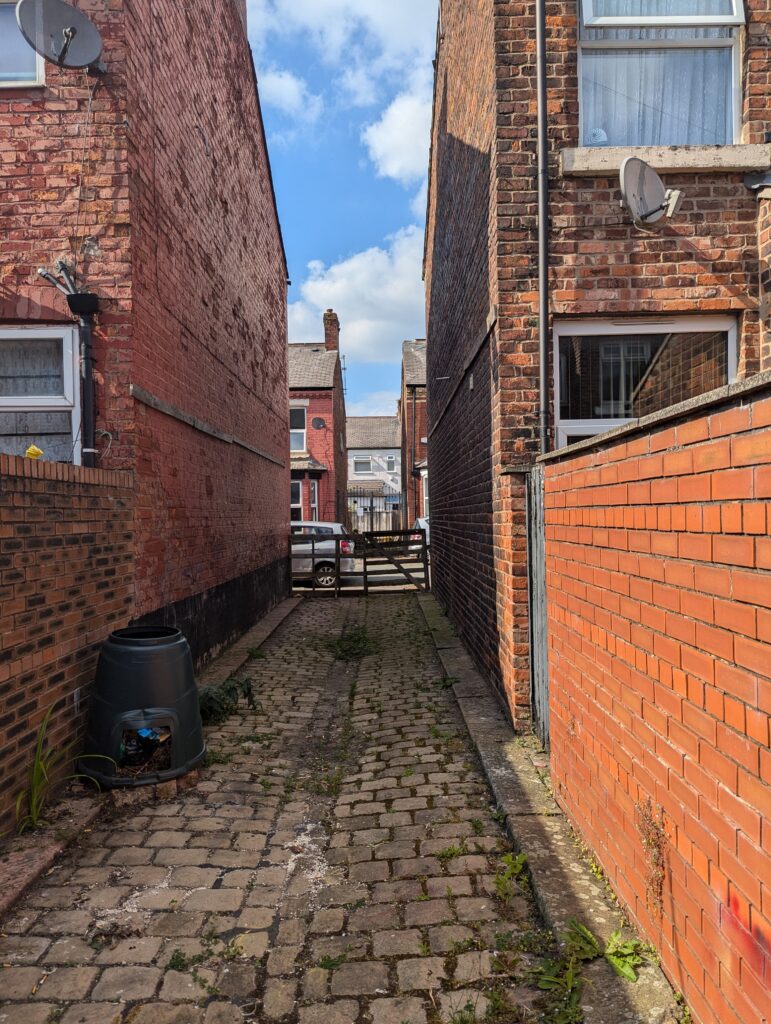
We cross the road to where the houses are red-brick terraces, with alleys at the back. Naturally, we take a shortcut through the inviting alleys and find ourselves immediately in an oasis of a back alley, abundant with flowers, art, friendly painted signs and a friendly neighbour, working away. We stop for a chat and discover we are in Origin Alley, believed to be the first alley garden transformation in the area.  Our impromptu host, Martin Callery, takes us on a walk along the main spine of the alley, which is unusual in that it has a series of unlocked, low, wooden gates creating different zones that we are told are for keeping dogs and children in. One such zone is fully decked, while the rest of the alley is cobbled, with grass and wildflowers growing delightfully in the cracks. There are planters made from baths, an old fridge turned on its side with a lovely painting on the front of it and various other pots and containers. Fruit trees reach their branches, abundant with fruit, across the walkway and we duck to pass under them, taking in wall art made from jar lids and broken mirrors as we pass.  Two kids walk through the alley end with their Dad, as we chat, making their way home from school. At the angled walls of the alley’s T-junction, there is a fireplace with a skateboard above it, painted bike wheels, and a golden female bust artwork we are introduced to as ‘The Medusa of Mosside’, made by martin, but he assures us the lacey undergarments were a later adornment, not by him! 

A few streets up and over, we find Yasmine in the alley, busy watering. The blazing sunshine we’re experiencing is a key difference between home and here, this just might be the hottest alley walk we’ve ever been on – and we learn that watering the plants in a communal alley is an extra challenge since in England, water is a pay-by-usage utility per household and it’s rare that these kinds of houses have outside taps. 

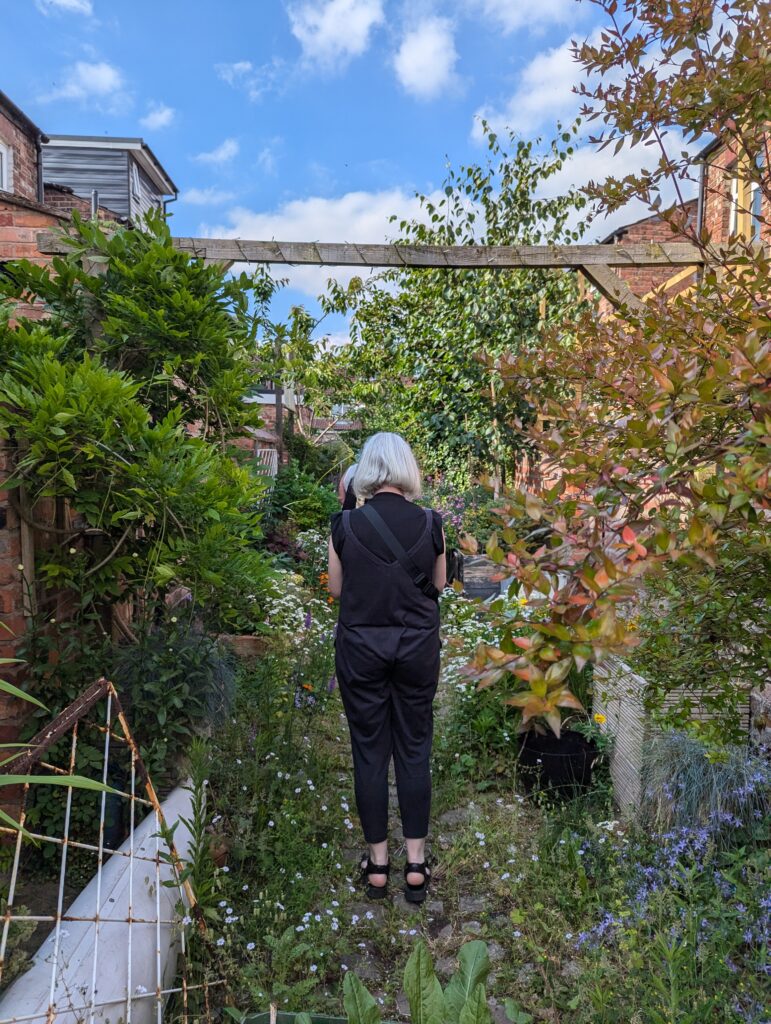
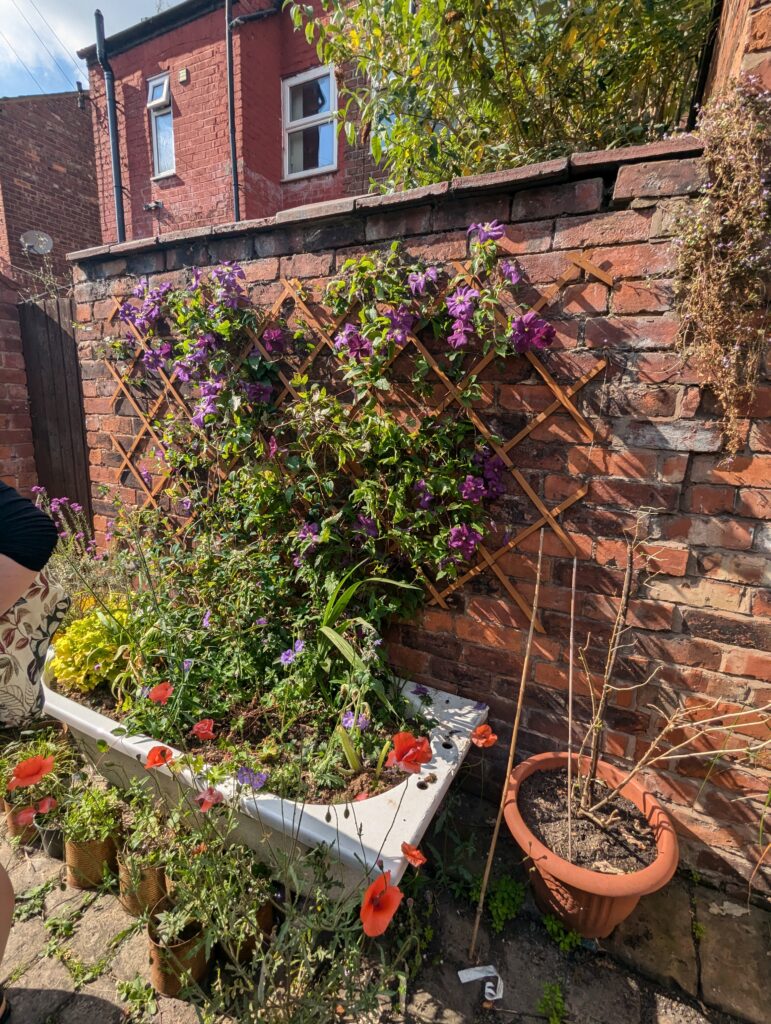
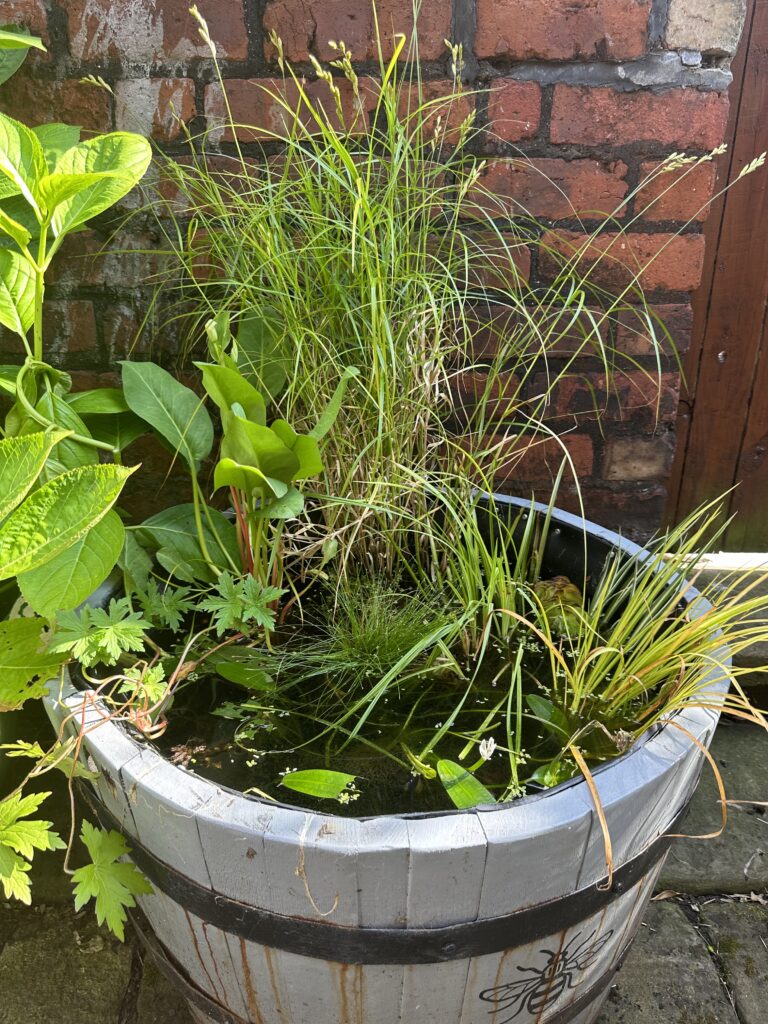
But hot or not, from what we are seeing this alley is lush! There’s multiple levels of planting, hanging baskets, raised beds. Bathtubs repurposed as planters seem to be the Moss Side signature style. A motif of colourful painted bricks runs up the whole alley, a clever way of adding a pop of colour without having to paint entire walls. They’ve been greening the space for 6 years now mostly without any significant funding or formal support but it’s a building movement and there have been some key collaborations spurring things on. 

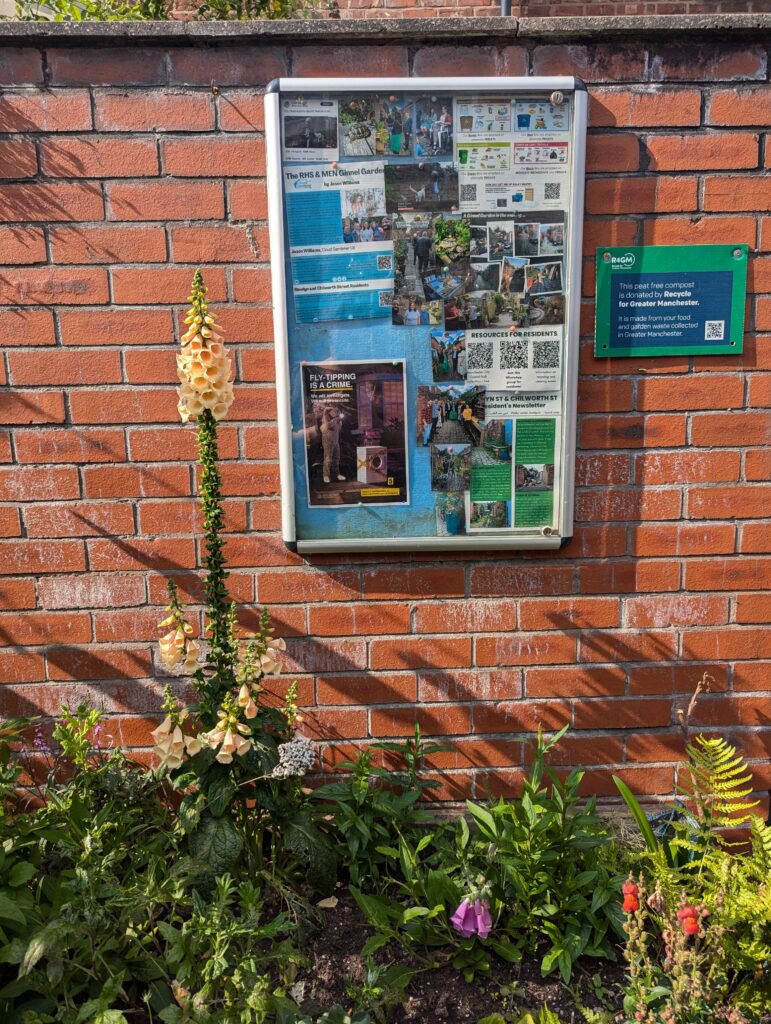
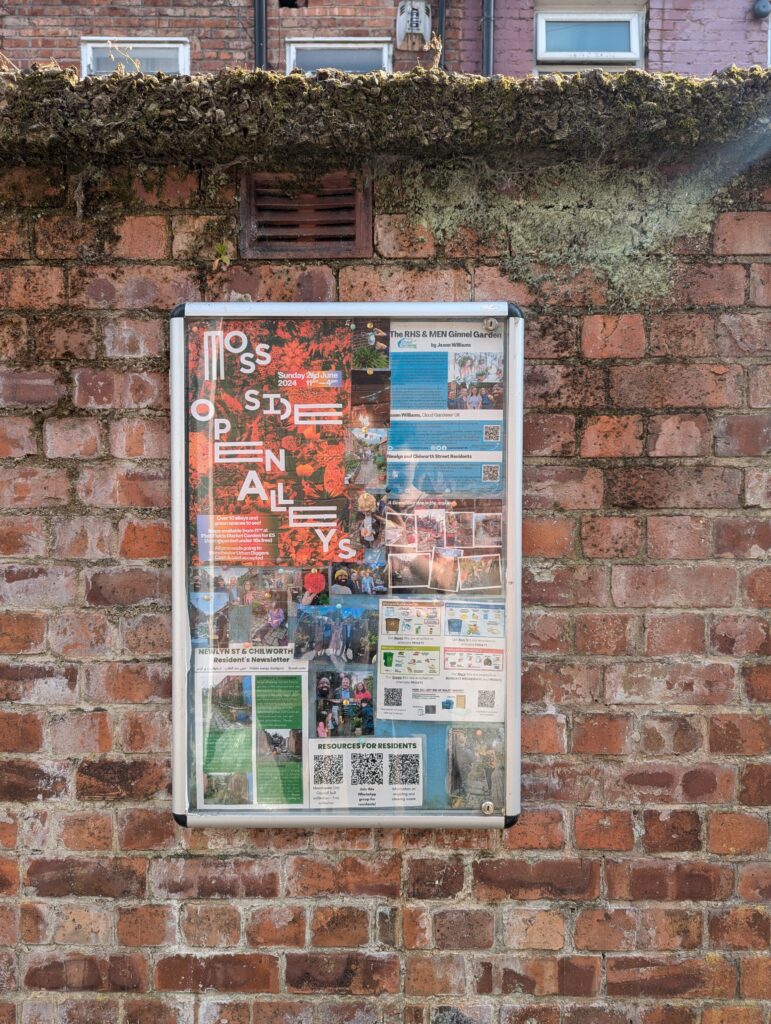
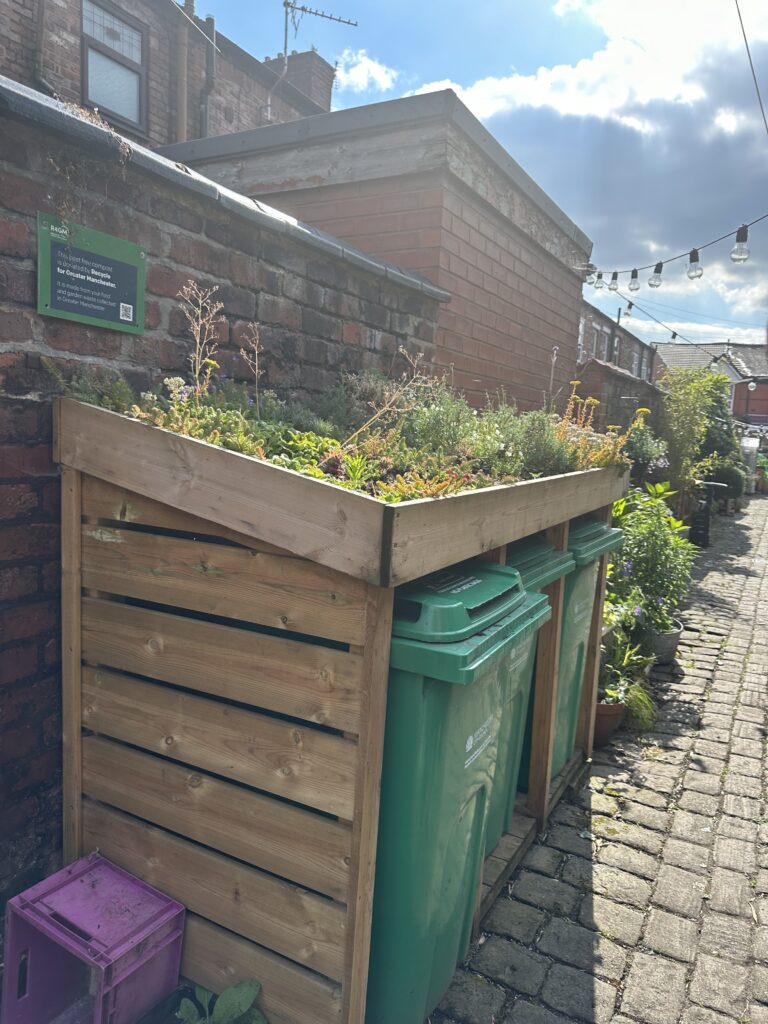
Yamsine shows us the recent ‘Moss Side Open Alleys’ poster on a community notice board. She tells us what an amazing response they had for the event – hundreds of people turning up from all over to have a look. There are pictures from their collaboration with Jason Williams, Cloud Gardner UK, who used their alley as inspiration for his Manchester Flower Festival display. Some of the plants and other materials have been gifted back to it including an amazing bin-store with a green roof. Just like at home, you can’t talk about alleys without talking about the bins. Some streets in Moss Side have communal bins and others have moved to individual bins per household system. There are pros and cons to both methods we learn, but when used properly communal bins allow much more space in the alley itself. 

 There are lots of edible plants, but it still feels like a garden, not an allotment. Apparently the question of what should be grown, flowers vs food, can be a source of tension but surely this alley is showing us that there is room for both? Cloudy Alley collaborated with Jason for another urban garden design project “Nutrion-alley” looking at the potential for home growing food in an alley. It’s a great name and we talk about the work we’re doing with Laurelbank Farm back in Belfast on alley food growing potential – we’d love to swap more detailed notes, another time hopefully!

We talk about the makeup of the area, the social problems with high levels of renting, relative poverty and food scarcity. It’s hard to keep your community engaged and connected when there’s so much turnover and transience.  At the other end, there’s another community noticeboard with info on recycling, QR codes with resources for residents, available I think in at least 4 different languages – a great gesture for welcome and inclusion. 

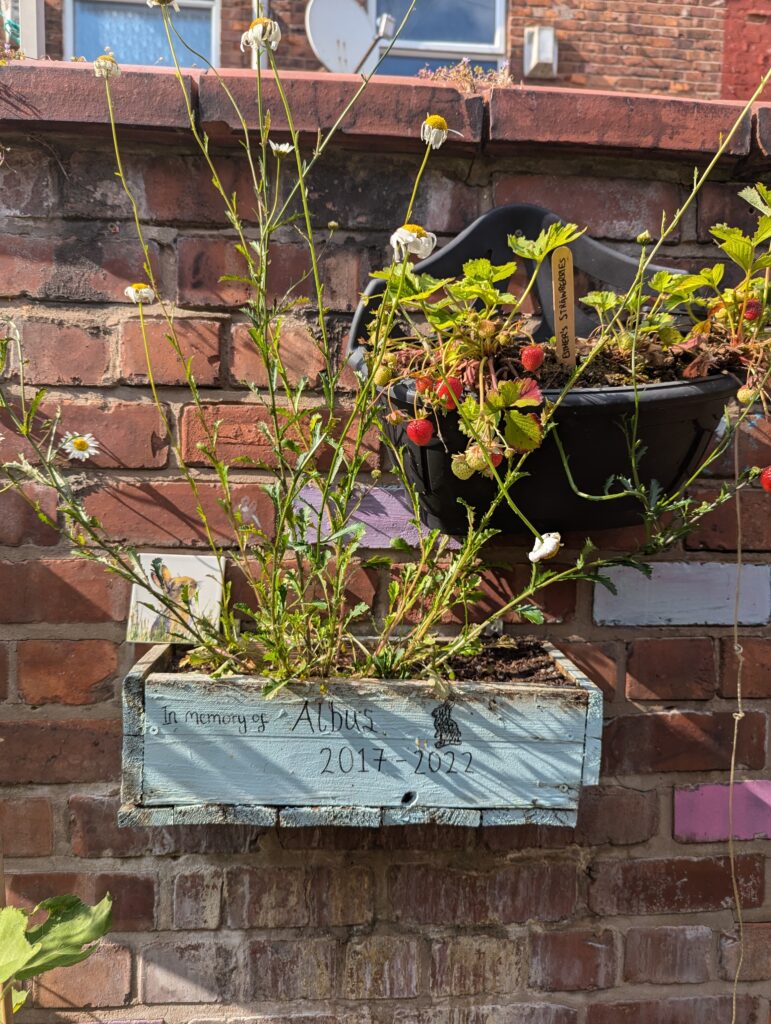
Yasmine brings us to Sunny Alley which is the next street over. This one started first and it was named after a person not the weather but the name kind of stuck and now Sunny and Cloudy are a bit of a double act. The same coloured brick motif adorns the walls but there’s a different vibe. Yasmine explains there are many more families on this street and you can feel it in the alley. Lots of additions for and by young people. We can see some pet memorials, some toys and play materials. 

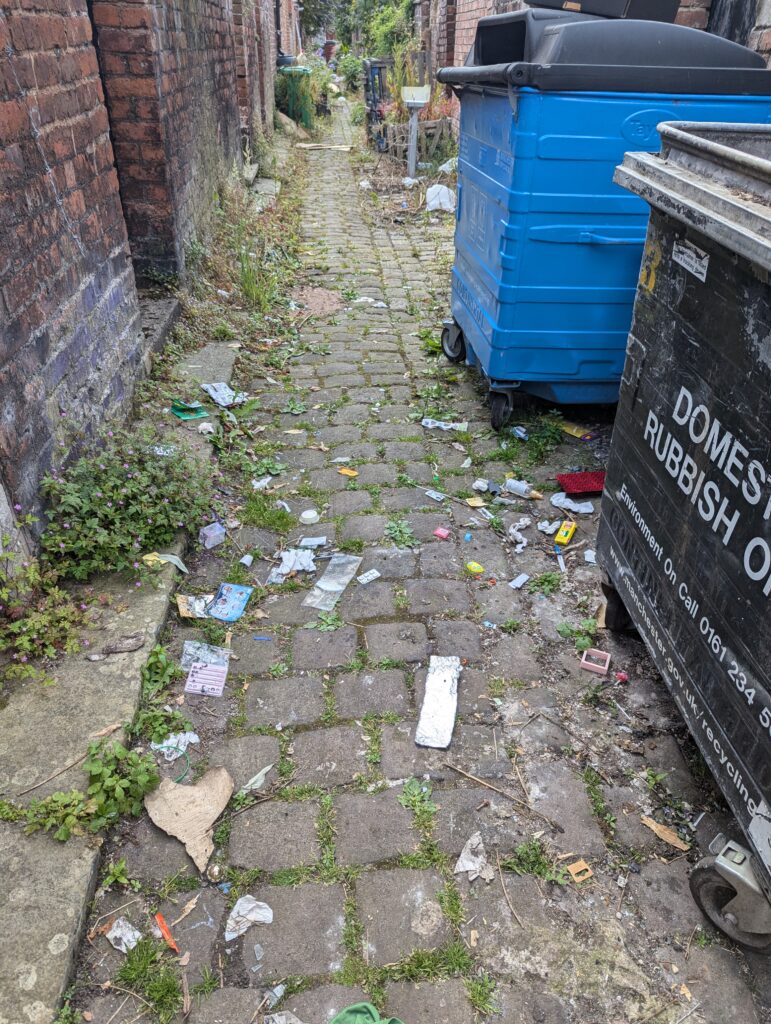
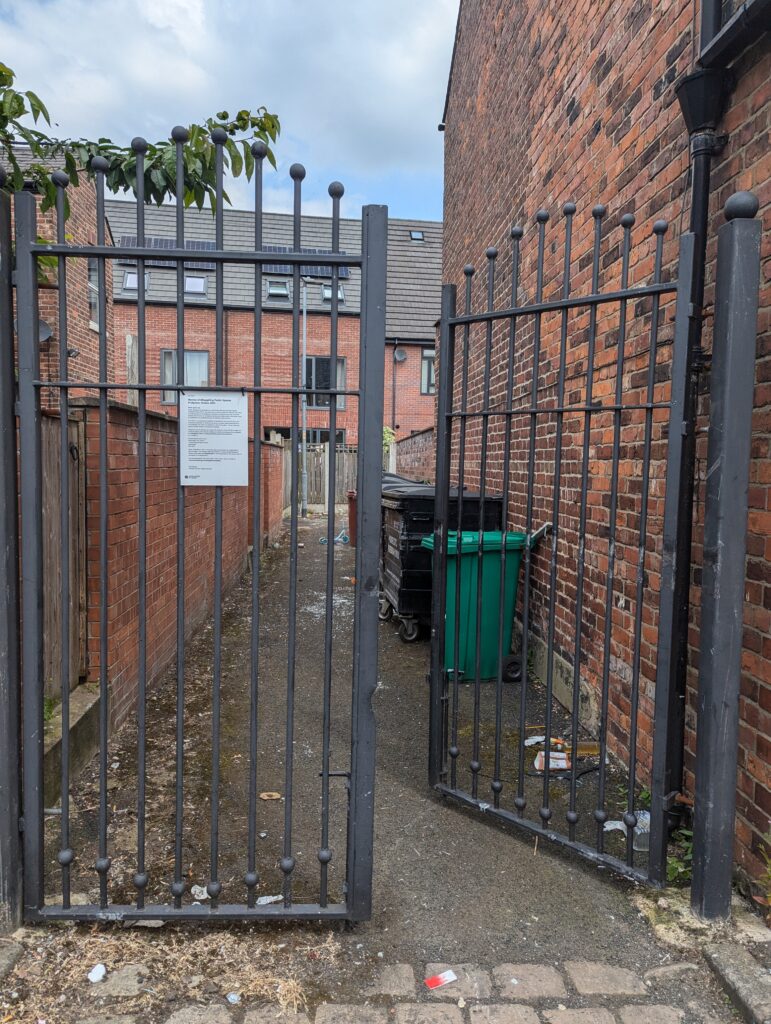
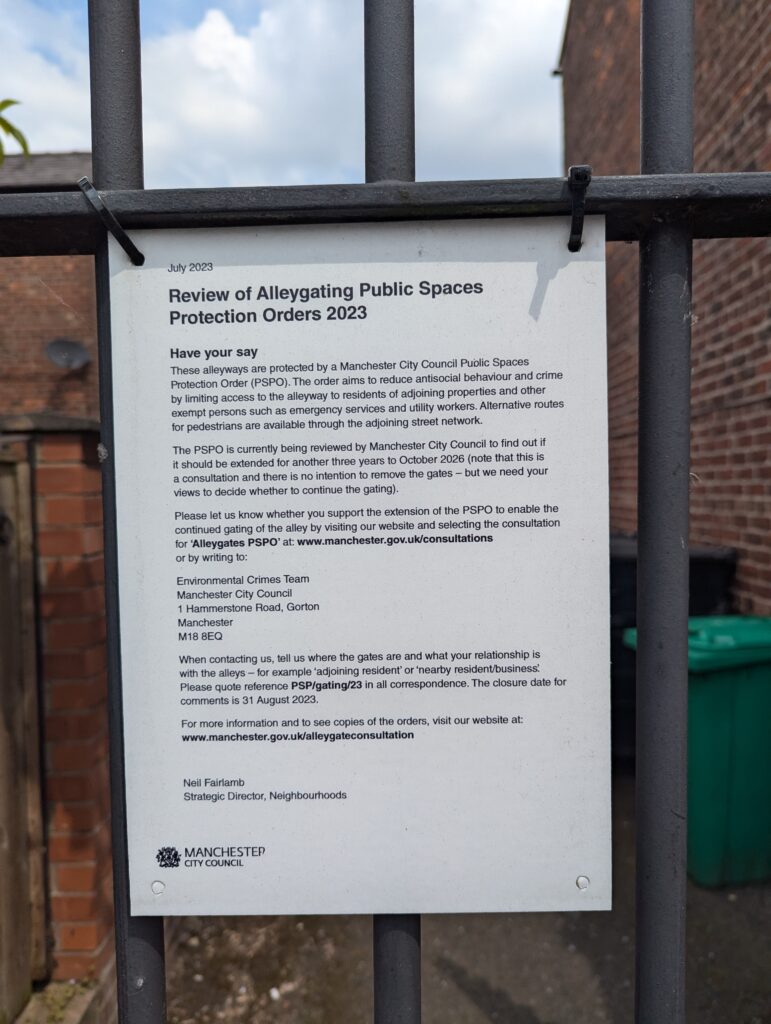
There is a DIY gate on one of the exits here. These alleys are due to be gated very soon, fence posts have recently gone in. Like at home it’s a lengthy process involving the City Council and the Department of Infrastructure. There are also various issues about ownership, some alleys can’t be gated as their ownership is unclear. Just like home, there’s no one size fits all solution but most of the residents are in favour of the gates as they feel it will make the alley a much safer space. The gates we’ve seen here are much friendlier, still black, still metal but they don’t have the same prison architecture aesthetic – we wonder how much they cost? We don’t think we will ever come to love gates but we could learn to live with these ones. 

It’s been really inspiring visiting these spaces in person. To walk, to learn and to consider. It has generated lots of food for thought and we are looking forward to meeting more residents and like minded alley-aficionados tomorrow!