Categories
Journal

A Manifesto for the Alleys

9ft in Common: A Manifesto for the Alleys is an exciting city-wide project investigating the creative potential of alleyways, stretching across Belfast from Ballyhackamore to Andersonstown, Newtownbreda to Ligoneil and everywhere in-between. 

This initiative will take place in Belfast in 2024.

9ft in Common: A Manifesto for the Alleys is developed and directed by Starling Start and Studio idir, in partnership with Social Farms and Gardens, Laurelbank Farm, and the residents of Belfast. We’ve been able to grow our core team and have big plans in the pipeline.

This year, we’ll be following the seasons with an exciting programme of workshops, artistic commissions, participatory budgeting (letting YOU make improvements to YOUR alley), hands-on action research, shared resources and LOTS of creative responses.  

Are you ready?

Watch this space for more details, or, better still, to be the first to know about upcoming events, resources and opportunities within this new stage of the project, subscribe below

Find out more about our project partners
Social Farms & Gardens & the Reclaim the Commons Network
Laurelbank Farm

Categories
Journal

Alley Alley Alley

…or is it an entry, or a snicket, a close, a ginnel, a venelle, a lane, a wind, a loanen.

We’ve been thinking about place names. Naming a space and creating a place. We asked the Northern Ireland Placenames Project at Queen’s University Belfast to consider words for alleyways and to help us understand how places are named. The project researches the meanings behind place names. Our approach is ‘upsidedown’ as we’re seeking to find names for alleyways that have none.

We talk about naming patterns and strategies. What methodologies do land developers use in the present day? What is the policy for this? What is the protocol? 

Perhaps it’s a chance to reinvigorate a townland or historical name. We could look at the view, colours, animals, plants. In urban areas place names are often commemorative names (like the city centre entries: Joys Entry, named after a person)

We talk about languages. Some names have Irish, Scots and English roots, like Burtollet River, which essentially translates as ‘river river river’ in Scots, Irish and English!

Can we apply this hybrid naming to alleyways?

One of the most common NI place name component is Bally, taken from both Baile (town) and Bealach, which means ‘road and pass’ in both Irish and Scots. Smugga is Scots for ‘a path between two fences, an opening or passageway in a piece of land’.

There we have it – Bealachsmugga Entry (= alley, alley, alley)!

Categories
Journal

A Conversation with the Alliance Party

Alliance Party have been successful in having £500,000 of Belfast City Council rates money to be set aside for the next phase of alley gates with the Belfast area. We were keen to meet up to find out more.

We meet with Councillor Michelle Kelly who describes seeing potential in alleyways as new: “It’s only recently that people are seeing the opportunity in these shared spaces.” Michelle notes the lack of joined up thinking whilst attempting to solve alleyway issues. 

We talk about the alleyway success stories as inspiration for others who are attempting to transform their alley and Michelle describes impromptu sing-songs with neighbours in her own alleyway, creating a sense of community.

We get to the subject of gates. 

Michelle believes that gates are not the solution that everybody thinks they are. We show Michelle some of our concept designs and she responds “You’re not going to be able to gate every area with £500,000 so it’s a valid point to think about other options.” 

We ask for an update on the BCC alleyway transformation scheme and evaluation and ask if there’s room for manoeuvre on how the £500,000 will be spent. “It does depend on what the evaluation comes back with but I think this round will go ahead on the gates.”

Michelle would like to let people know how to transform their alleys. We acknowledge the DFI alleyways greening fund and Michelle talks about the role that alleyways and residents can play in the 30 by 30 campaign which is about recalling 30% more land for biodiversity projects or pockets by 2030.

The campaign seeks to ‘educate, inform and support citizens and communities to maximise the green spaces they have around their homes to support urban biodiversity throughout the city.’

We agree that alleyways can play a huge part in creating green corridors for both wildlife and city dwellers.

Categories
Journal

Alley walk exploring newer alleys

After our meeting with Housing Executive, we decide to focus on an area where we know they own the alleys. 

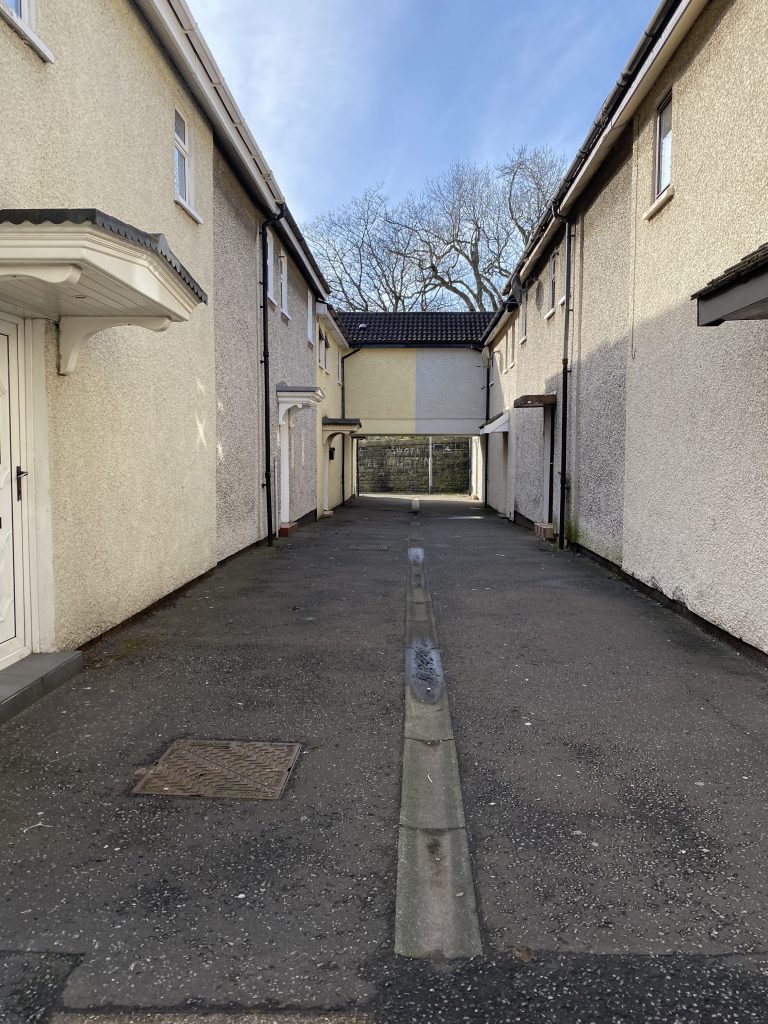
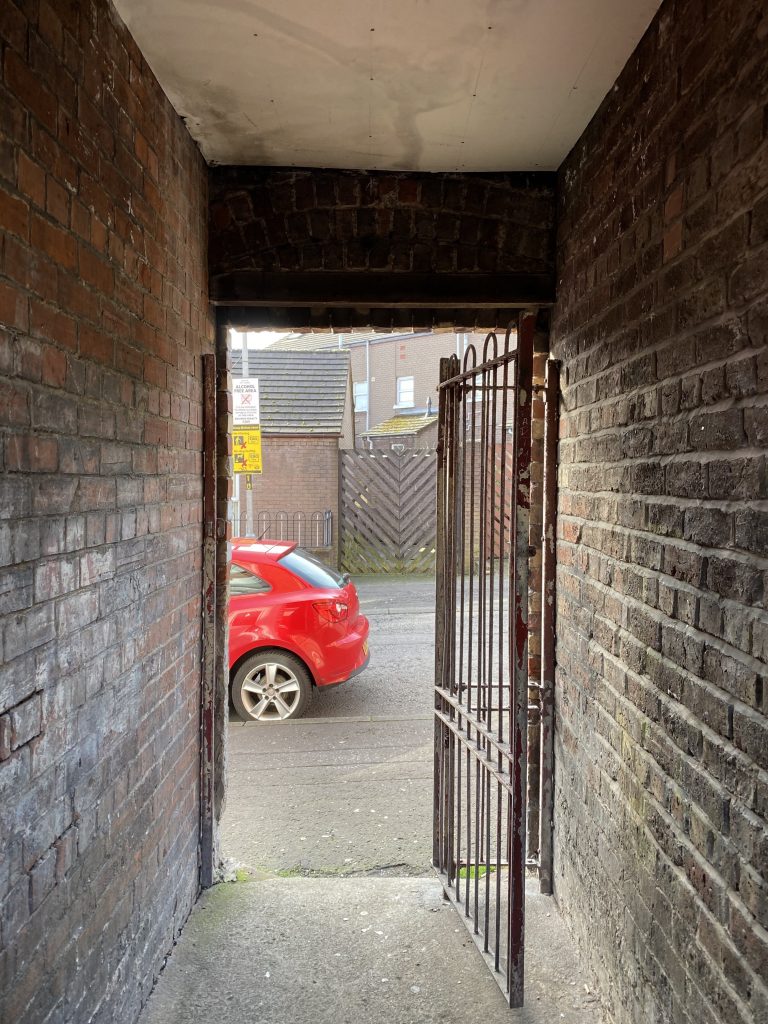
1980s housing estate alleys, today. Alleys with gates lying ajar. We go inside and back out the same gate.

Wider alleys now. Are they alleys, though, these pedestrian streets we find ourselves on? On this experimental estate they are the front entrance to houses no car can reach. Not a back alley, then, but very much a front.  Also an affront – there are no windows at ground floor level.

Disorientating, they all look very much the same. You could get lost here. Even where there are adjacent roads, the backyards face these and the houses turn instead towards the alleys. Introspective. Not much sign of life on these pedestrian streets. There is one grass green amidst them, three lonely trees and a low fence all the way round.

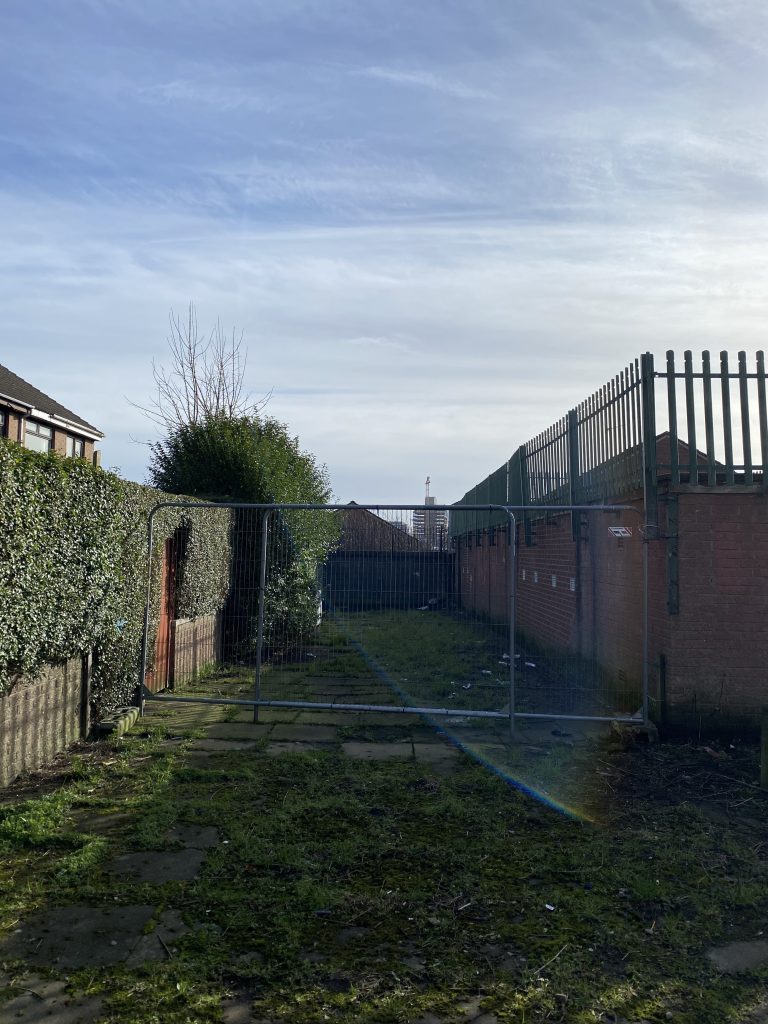
Concrete bollards to keep cars out. Oh wait, a makeshift gate to create a barrier.

Past the highrise flats and into some proper back alleys. Many are dead ends with only one way in or out, and many have gates lying open without a lock.

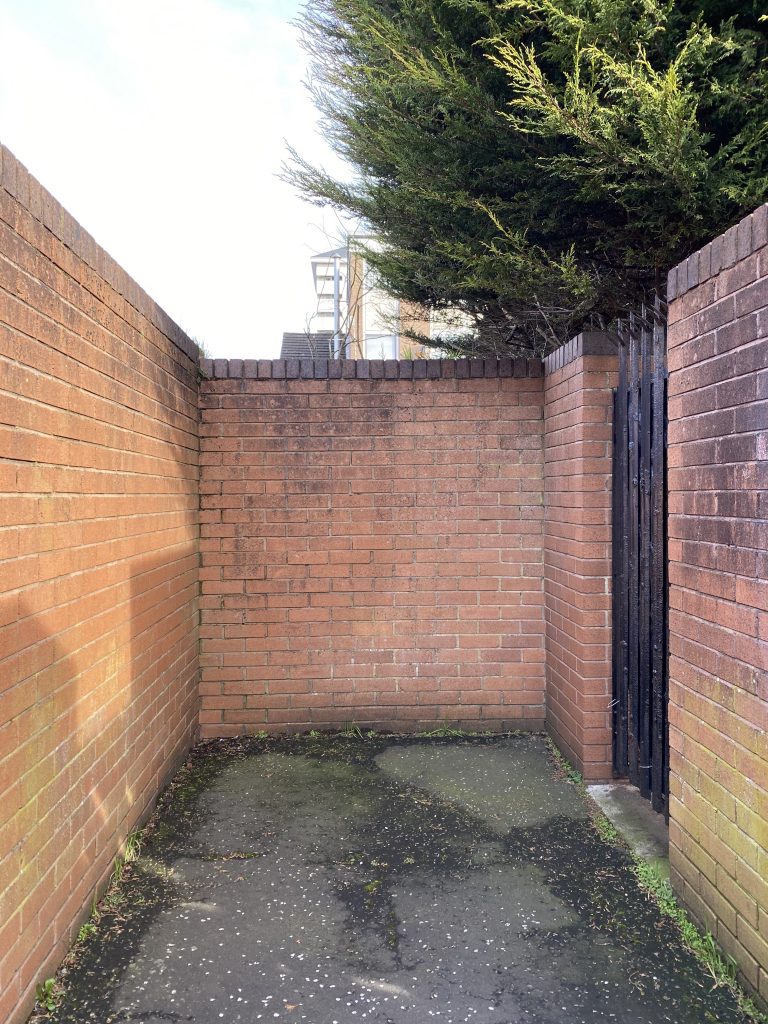
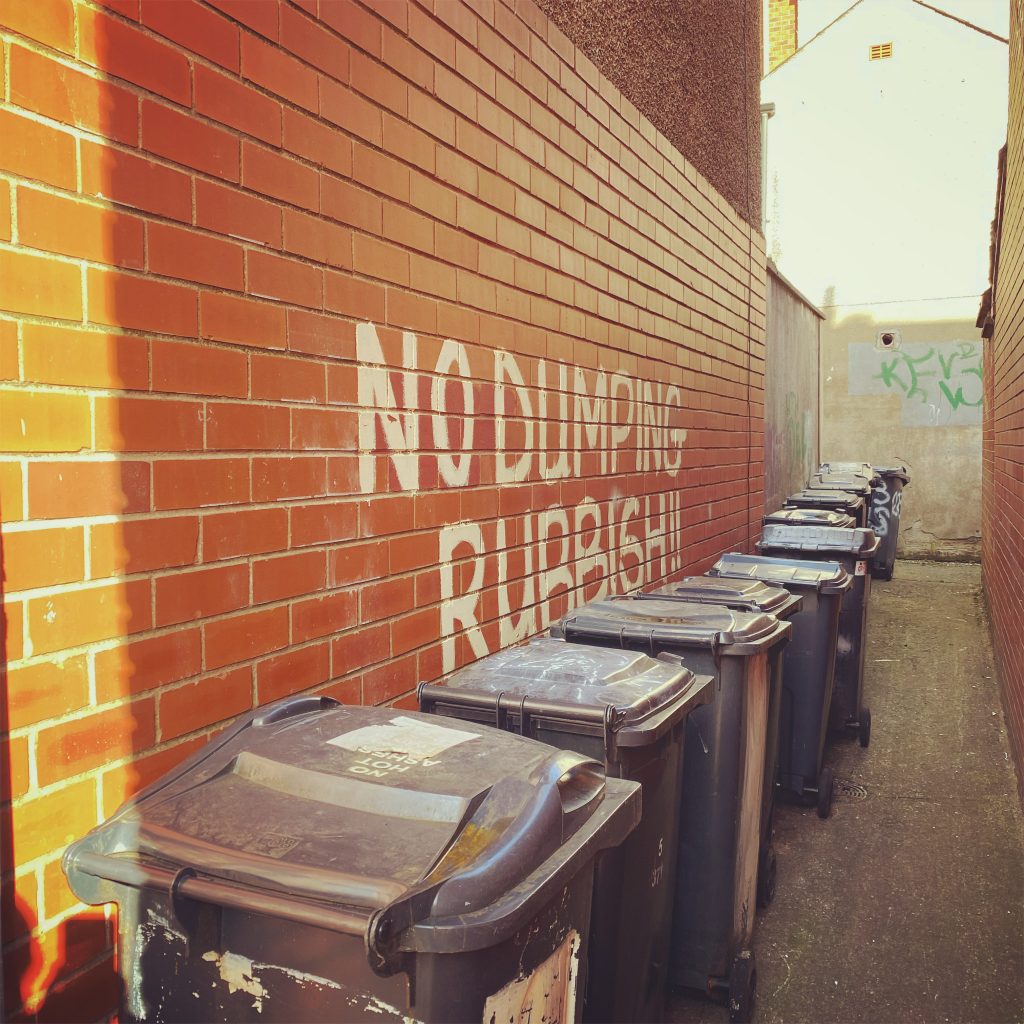
In other places gates padlocked or screwed permanently shut dictate our passage along the only route available to us. We reach some older houses with more typical back alleys, then, weaving our way in and out of interface gates along a peace line, and we check some of these out.  ‘No Dumping Rubbish!!’, orders a brick wall – and it is heeded.

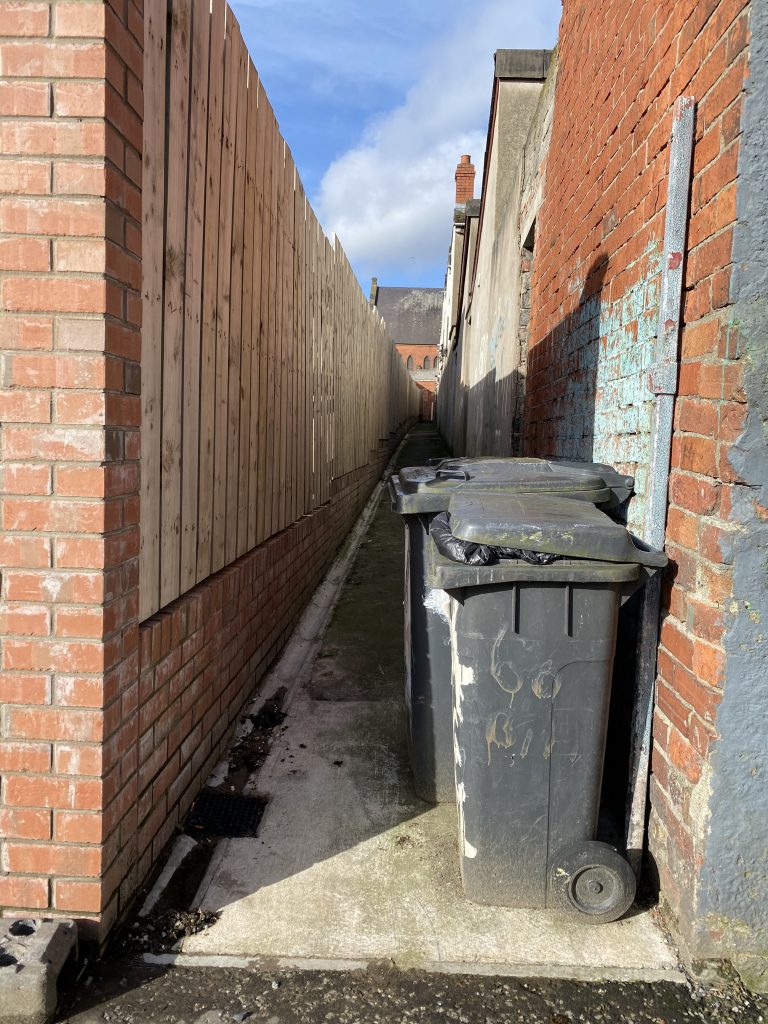
Red gates, black gates. They’re narrow, inviting alleys, quite tidy with little graffiti, personalisation or signs of life, save for ubiquitous dog poo and the bins, sitting expectantly at the ends, preparing to unload their burdens into the bin lorry.

Categories
Journal

A conversation with Housing Executive Placeshaping Team

We meet with the Placeshaping Team from Housing Executive (HE) who own the ‘bed and soil’ of a lot of Belfast. This land will have been adopted by DFI, although they have recently noted a gated alleyway which is ¾ adopted and ¼ unadopted. HE have an Estates Team responsible for maintenance. 

We ask if there’s a map to indicate ownership of their alleyways. It would be an ‘arduous task’ to map ownership of all alleyways, but they can search by area if we’d like to request that. They may be able to get us a data share agreement so that we can access their data. They will check to see if they have lists of HE gates that we can include within our mapping.

Gated HE owned alleyway

They do have issues of flytipping and requests for gates. Sometimes these gates are installed by Belfast City Council and sometimes directly by HE. They do no formal evaluation of gates, relying on tenants to raise issues. 

The 1980s housing estates are problematic – quick getaways for antisocial behaviour. There have been instances of stone throwing and kids escaping down the alleys when police arrive. They point to where on a map. A great place for our next alley walk!

They are unaware of any positive alleyway stories, but Local Housing Community Reps (3 offices in Belfast) can share the call for alleyways stories with their tenants. They believe tenants will be interested in a toolkit around alleyway transformation.