
Categories
Journal

Perspectives from Germany

We love getting different perspectives of people from outside Belfast!
Birgit was undertaking a Masters in Urban Planning at the University of Kassel in Germany and was interested in the ideas of urban commons and unclaimed spaces. Birgit is now a Research Assistant at University of Braunschweig. Photos courtesy of her, taken during her research visit.

Examining the ‘Backside of the City’ – What the Belfast Alleyways taught me about Common Space

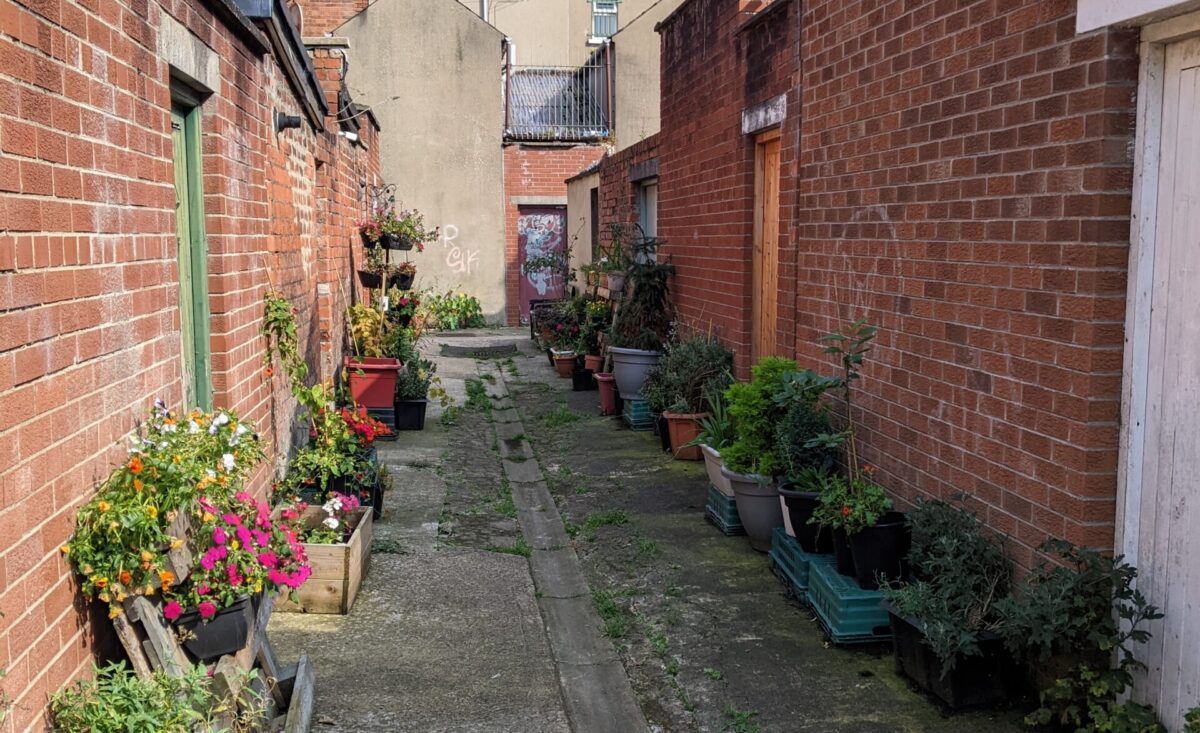
When I heard about 9ft in Common and their research in and around the Belfast Alleyways, I soon got drawn to this very special type of urban space. In Germany, where I come from, we hardly have any terraced houses. The single-family home dominates suburban areas, whereas in cities people live in apartment buildings that are up to 5 floors high. We do have a lot of closed backyards, but no alleys. 

This led me to choosing the Belfast Alleyways as a topic for my Master thesis and examining how they offer space for Urban Commons. During my research I soon found out that they are in parts maintained by Belfast City Council, however most of them are not really ‘owned by anybody’. What a great prerequisite for Common Space, I thought. I went for a lot of alleywalks during my research phase in April 2024, I could feel – what Meadhbh told me when we were strolling through the alleys of her neighbourhood – as soon as people start to use these (at first glance very narrow) spaces, they magically appear bigger. 
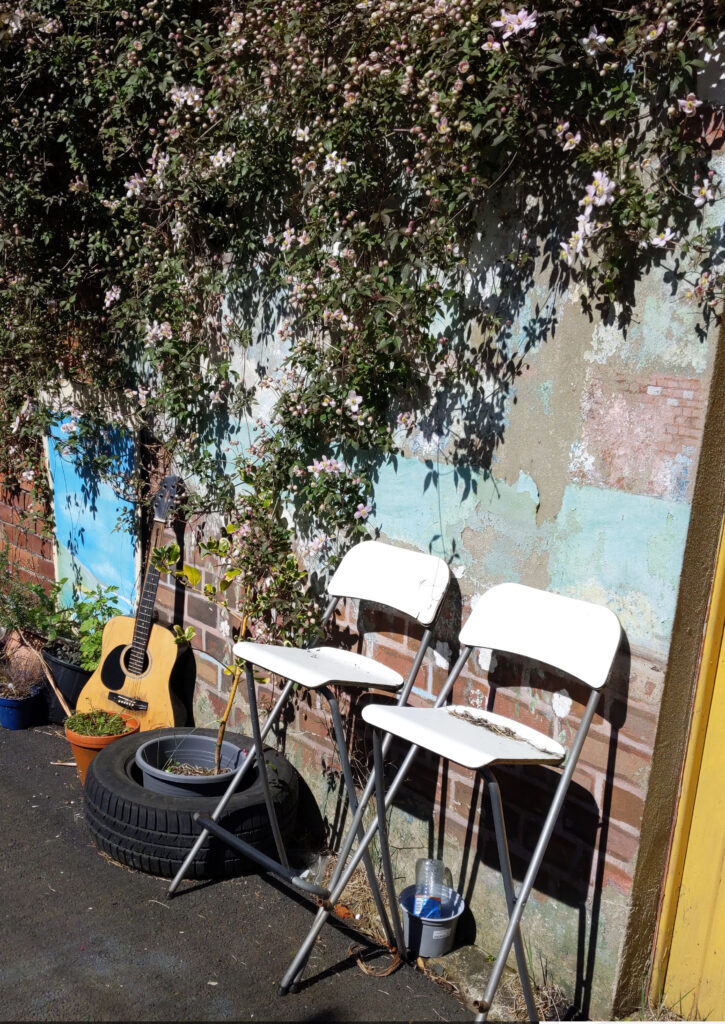
a sunny spot – small touches can make it look so inviting.

I got in touch with Bríd Ruddy, one of the founders of Wildflower Alley, who showed me her neighbourhood in the Holylands and made me realise that claiming ownership of the space behind your house also affects how you perceive the front of it. You might become more aware of the need for Common Space in your city in general, especially in a densely populated area like the Holylands. 

But what does an alley need to be “claimed”, and furthermore, “maintained” as Common Space? Who claims and who maintains? How does the capitalisation of Housing influence the alleys behind those houses? Is the promise of safety and security that the current gating process makes, fulfilled? Does it only apply to the safety of residents or can it be interpreted as security for capital investment? 
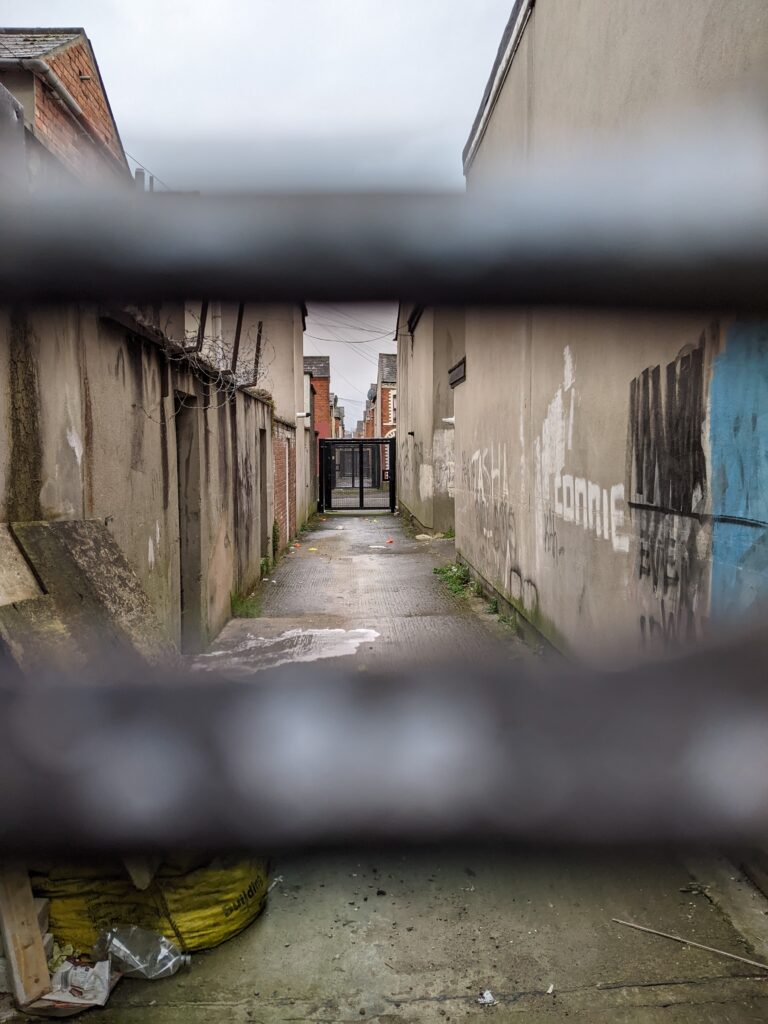
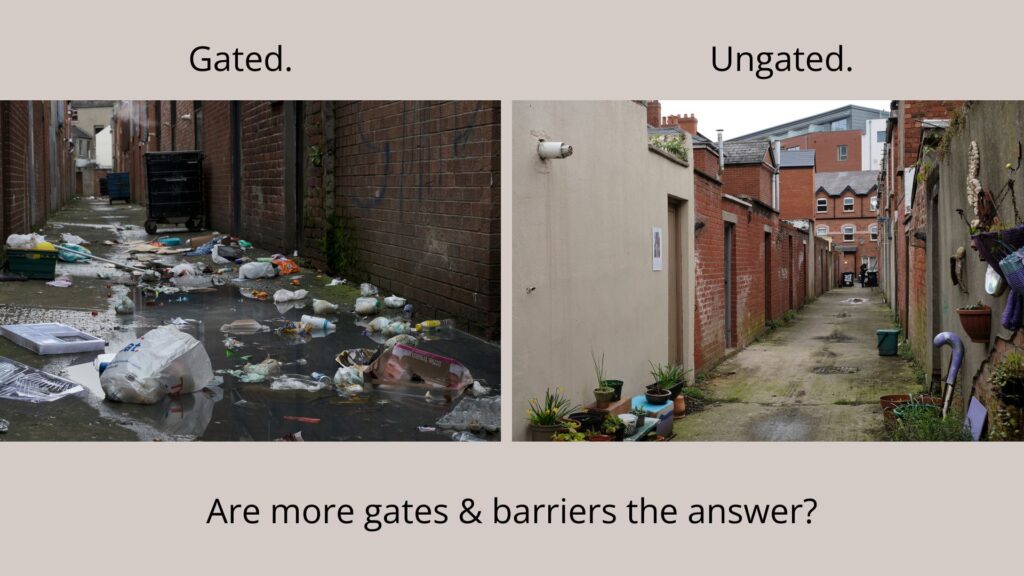
Alleygating – there are pros and cons.

A lot of questions arose during my research on the alleys in South Belfast. In Bríd’s case, the gates surely were a necessity to make Wildflower Alley flourish. But in other areas I wasn’t so sure about people’s intentions of wanting gates for their back alley. After all, the security paradigm in Great Britain and Northern Ireland and the control of public space that comes with it, are still very strange to me. In Germany, we also like to lock our front and back doors, but further security measures and surveillance for private residences are still very rare. Strolling through the inner city alleys of Belfast, I realised that chicken wire and cameras might make the residents feel safer in their homes, but also give passers-by an impression of walking through an unsafe area. But – I am first and foremost an outside observer. The way I see and use the space differs from the way people who live in Belfast or grew up here might see it, a fact I always tried to keep in mind during my stay.

There are also structural requirements that make an alley usable. Not every passage has the capacity to become an Urban Garden or Urban playground for residents. Some shorter, more open alleys are good pathways and nice short-cuts to avoid busy streets. But isn’t that Common Space, too? Does anyone feel responsible to claim these transit spaces for Common use? And with that in mind, doesn’t the gating process regarding those alleys make them unusable in the long run?
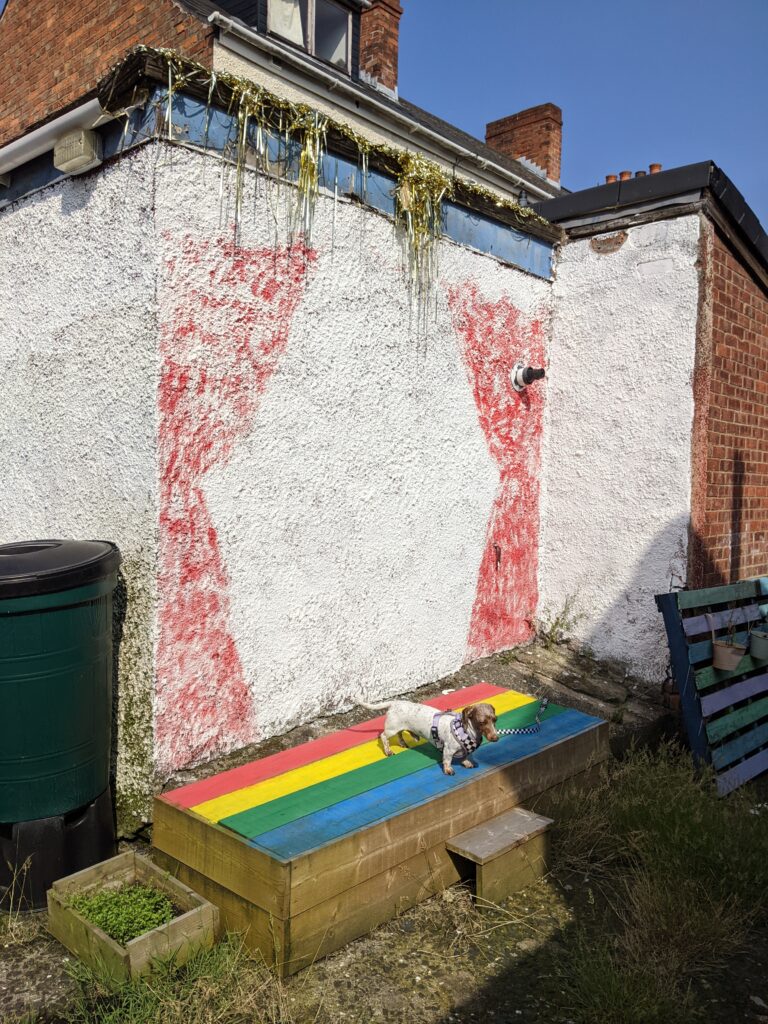
Birgit’s sister’s dog takes on ‘the stage’ at Rainbow Alley, East Belfast.

I did find some answers to these questions, but an even greater result of my field trip to Belfast was that it is not only the Common space that has to be claimed and maintained, but also the social process of making Common space itself. It is a permanent negotiation that requires resources, but it also takes willingness and belief in democratic principles. This may sound dramatic, but it reflects decades of scholarly research on Urban Commons. Cities are always on a threshold of new development, some may be unplanned or unplannable. It needs groups and individuals that are willing to actively shape their city and (in the big picture) also society. 

In 1968 the economist Garret Hardin coined the term “the Tragedy of the Commons” in his essay of the same name. He declared that the Commons are damned to be overused and exploited because people are driven by self-interest and the maximisation of outcome. This theory has long been refuted by scholars that dug into the Commons as a research topic. Elinor Ostrom, a scholar of environmental economics, being one of them. She conducted studies that proved Common resources can be preserved and what people needed to achieve that. But even as the Belfast Alleyways showed me what is possible when people take action, particularly driven by the social experiences of the Covid pandemic,a lot more could be done. 

While many local authorities would agree, that the idea of (Urban) Common Space is worthwhile, they do not seem to see it when it is right in front of their eyes: Space that is owned by everyone and no one, and people who are willing to cultivate this space for the better of everybody who’s using it. And despite all the Common force I found in the alleyways, administrative bodies and planning departments seem quite inert when it comes to integrating these developments into their concepts permanently. 
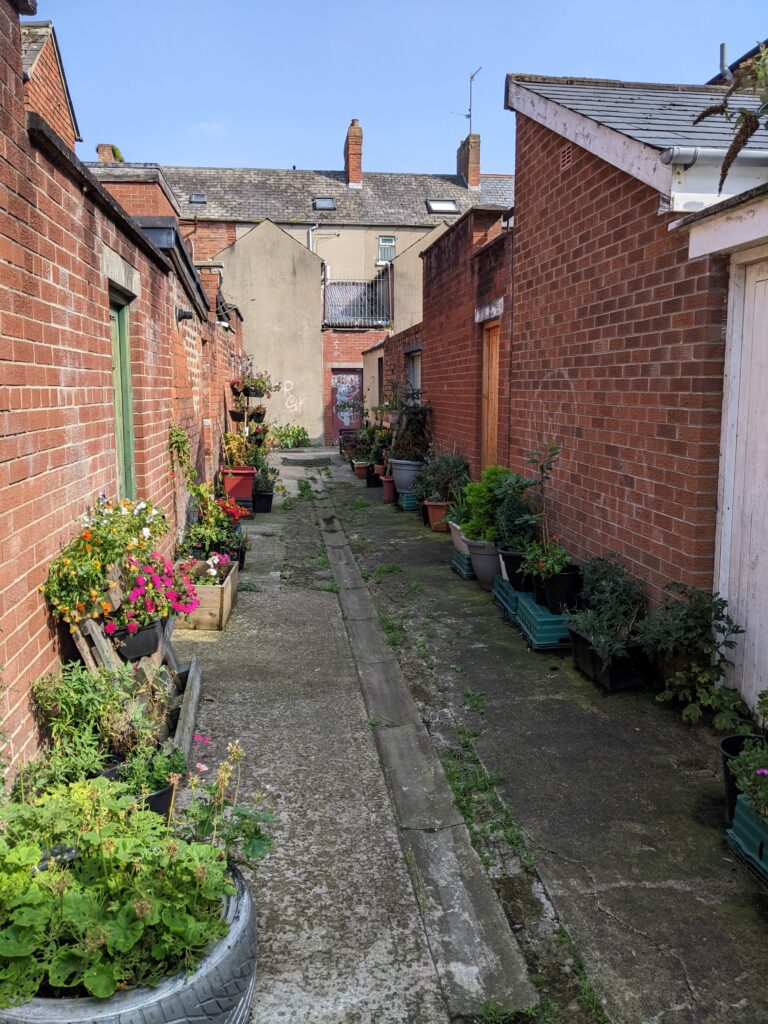
Rainbow Alley: I like this photo as it shows how much can be done with little adjustments.

__

I am very grateful that I have gotten insights into the network of Belfast Alleyways. Thanks to Bríd and Meadhbh who showed me their neighbourhoods. Also Aisling and Amberlea, who I didn’t meet personally, but who let me make use of the knowledge pool they created and curated online. Thank you all for letting me be part of this project and hope to see again you on my next visit!
Categories
Journal Resources

Debate the Gate?

Are you affected by or concerned about the recent alley Gating Order? 
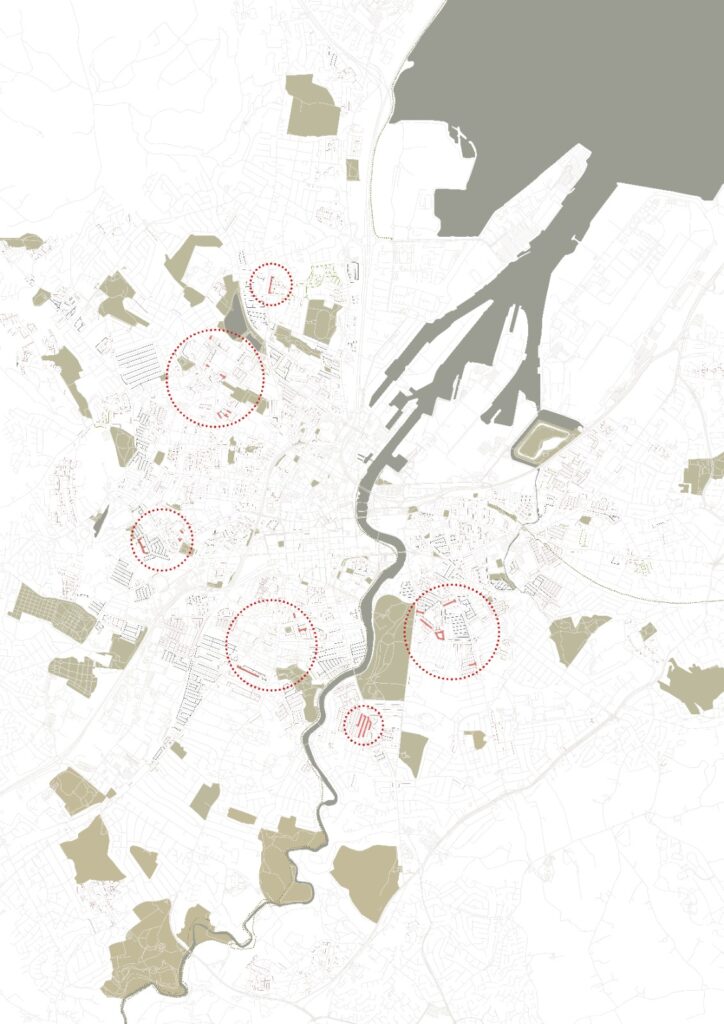
Areas listed on Gating Order 2024

Perhaps you are on the fence about whether gates are the right solution for your street.

If you feel you have not been given enough information or enough time to discuss it properly with your neighbours or that alternative solutions have not been considered for your area then YOU HAVE A VOICE and can send an objection letter, in writing by post/hand delivery to:

Belfast City Council 
℅ Gavin Bell,
City and Neighbourhood Services Department.
4-10 Linenhall Street
Belfast BT2 8DP

BEFORE close of day on Friday March 8th. 

We understand that each area is different and that there is not a one-fits-all solution but debate and democracy is what local government is for. 

9ft in Common have concerns based around ideas of alleys as rights of way, the legal requirements for community consultation, the evaluation of previous gating orders (have they worked?), and, if any alternatives to gates have been properly considered. 

We’ve put together an open letter to the entire Phase 5 Gating Order on grounds listed above. If you would like to add your name, please get in touch with us via email before 12noon on Friday March 8th- info@9ftincommon.com


Alternatively, you are welcome to use any of the points provided to write your own letter of objection. If you do not have access to a printer Social Farms & Gardens can print and deliver your letter if you email it to miriam@farmgarden.org.uk by 3pm Friday 8th March.


An Open Letter

Belfast City Council 
℅ Gavin Bell,
City and Neighbourhood Services Department.
4 -10 Linenhall Street
Belfast
BT2 8DP


Reference: Belfast City Council Traffic Regulation Order 2024 Phase 5a

To whom it may concern,

We write to object to the enforcement of the Gating Order 2024.

The objection is based on 4 points:

  • Objection point 1 – Rights of Way
  • Objection point 2 – Consideration for alternatives to gates
  • Objection Point 3 – Evaluation of gating orders
  • Objection Point 4 – Legal requirements for consultation

Objection point 1 – Rights of Way

As implied in the Roads Order, 1993, alleyways that have been adopted by the Department of Infrastructure, are public highways, and therefore legally, rights of way. 

Belfast City Council is duty bound to assert, protect and keep public rights of way open and free from obstruction. The duty to assert public rights of way is one the council’s most important duties under the Access (NI) Order, 1983. Blocking these routes with locked gates contravenes that order.   In some instances, gates have even been erected before an order has been passed, which seems hard to justify in light of the above.

Objection point 2 – Consideration for alternatives to gates

In the Guidance on Section 1 of the Clean Neighbourhoods and Environment Act (Northern Ireland) 2011 it states that:

Gating orders are not the only solution to tackling crime and ASB on certain thoroughfares. Before proposing an order, district councils should give consideration as to whether there are alternative interventions that may be more appropriate (and cost effective) for tackling the specific problems they are facing without having to gate the road.

Belfast City Council does not appear to have considered any alternative interventions. We request that Belfast City Council considers alternatives to alley gates, based on a thorough scoping and consideration of each alley in partnership with its residents and other local people who may use or pass through it, rather than a one size fits all approach that will reduce public space in the city, cost £500,000 and that hasn’t even been evaluated to see if it is effective (see objection point 3).  

9ft in Common has developed a series of alternative interventions which may be more appropriate (and cost effective) than gates. We invite Belfast City Council to consider these ideas, which have been developed through conversations with citizens, architects, planners, artists, councillors, council officers, meetings on alley walks and over zoom. They are sparked by the wonderful grass-roots interventions we have seen, and offer potential solutions to some common issues that occur in alleyways. They could be considered as alternatives to resorting to installing locked gates. 

We also refer to community-led Safer Streets projects that are prevalent elsewhere in England, as best practice ways of tackling ASB and crime, with work streams including ‘strengthening the local environment; and helping the community to reclaim its spaces and increase its strength and resilience.’

Objection Point 3 – Evaluation of gating orders

In the Guidance on Section 1 of the Clean Neighbourhoods and Environment Act (Northern Ireland) 2011 it also states that:

It is important to ensure that all gating orders are working as intended by undertaking evaluations of the gating sites to see whether local circumstances have changed. Therefore, it is recommended that councils review each of their orders on an annual basis. This review should evaluate whether the gating order is acting as a useful crime or ASB reduction measure. It should also assess the impact it is having on the community and discussions should be held with local residents to gauge whether the limited access is causing excessive inconvenience.

Annual evaluation of Phases 1 to 4 of alley gating in Belfast has never taken place.  Qualitative evaluation of Phase 2 gates acknowledged that, even after gating, there was continued ‘poor cleanliness in the alleyways as dumped mattresses, bin bags and dog fouling have been an issue,’ and some residents called for ‘a collective plan/multi agency approach to tackling ASB in the area’, which would suggest that the ASB had not been tackled by the gates. No quantitative or comparative evaluation of ASB and crime rates after Phases 1-4 appears to have ever been conducted.  In our own explorations of alleyways, we have witnessed countless examples of flytipping continuing behind closed gates, resulting in increased work for Belfast City Council who routinely clean the mess up without issuing fines or any further repercussions to perpetrators. 

Before any further gates are installed, we therefore call for a thorough independent evaluation of previous Phases of alley gating, to determine if the previous Gating Orders(1 – 4) have been successful in reducing ASB or crime.

Objection Point 4 – Legal requirements for consultation

Belfast City Council’s Consultation and engagement framework, 2020 ‘has been developed based on current legal requirements and best practice.’ 

The consultation process for Phase 5 gating orders falls short of this commitment. Hosting hard copy plans in community centres, wrapping around lamp posts or posting through the doors of immediate residents does not equate to a consultation that embeds:

 ‘meaningful consultation into the council’s planning and decision-making processes and supplements the commitments in our Equality Scheme and our responsibilities to consult under Section 75 of the Northern Ireland Act 1998’ (Belfast: Consultation and engagement framework, 2020)

The Framework also states:

We are continually looking for ways in which to improve how we engage and involve people. As part of this, we have invested in digital technology and have created a dedicated online engagement platform. The aim of the platform is to make it easier for our residents and other stakeholders to find out about our engagements and to have their say. We will also use the platform to keep people informed by letting you know what people have said and what has happened as a result.

Not using this digital platform and stating that objections must be issued ‘in writing’, by post, with a closing date on a Sunday, creates all sorts of barriers to responding. Further, the online survey was closed by the time of public notice, and therefore before a lot of people even knew about it or had the opportunity to respond. 

This process cannot be called a consultation. Some residents have expressed the view to 9ft in Common that the tight timeframe and format has not given them adequate time to consider the matter and discuss it with their neighbours.  We request that Belfast City Council carry out a proper consultation that is in line with their own framework of best practice, and allows for an inclusive, fair, open and transparent result. 

In Addition

In addition to these points of objections, 9ft in Common has been working in partnership with Social Farms & Gardens, Reclaim the Commons and Laurelbank Farm to deliver a series of capacity building and visioning interventions for alley residents and users. In the course of this work we as a partnership have become aware that the method of the current consultation is insufficient to allow residents and users to fully explore the option of alleygating for their street. We have anecdotal evidence that some residents do not want gates but do not want to risk upsetting their neighbours by raising an objection; others do not fully understand the consultation process or how to object. Some have voiced that through alley gardening with neighbours their opinion on the suitability of gates for them has shifted in the last year towards no longer wanting them. 

Because of this we ask that fuller consultation happens on a neighbourhood by neighbourhood basis, involving local community workers (e.g. Ballynafeigh Community Development Association) to deliver quality facilitated neighbourhood discussions, which will allow neighbours to process this decision together. To carry on without this level of engagement will result in loss of people’s public space without their consent or input, and could cause alienation in communities that are beginning to grow a strong and resilient sense of community.

We acknowledge the support to date from Counsellors regarding alleyway issues and we thank officers for listening to constituents and working to make the city’s neighbourhoods better and safer.  We hope they can support these suggestions that seek to improve the city’s democratic processes, connectedness and permeability. 

Yours faithfully,

9ft in Common